Materials
Cast aluminum vs extruded aluminum patio furniture
Both are aluminum and neither rusts. What separates them is weight, water, and what a freeze does to a hollow tube.
How this page is funded: Deck & Dusk earns a commission when you buy through the Amazon links below, at no extra cost to you. Commission never decides a ranking — our picks and our criteria are set before any link is added. Read the full disclosure.
Quick picks
One piece from each side of the comparison, plus the extruded frame that removes the cushion from the equation entirely.
| # | Product | Best for | Score | Price |
|---|---|---|---|---|
| 1 | 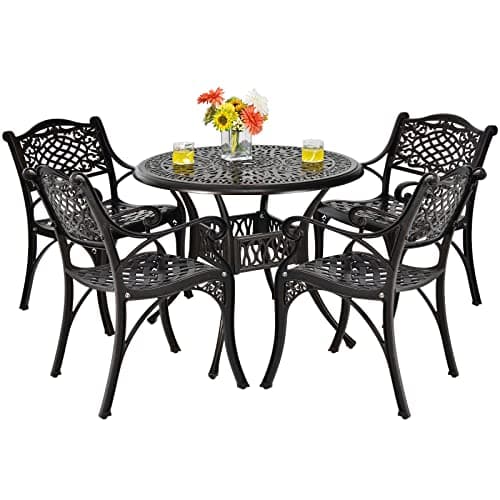 Tangkula 5-Piece Cast Aluminum Outdoor Dining SetSolid sections, enough mass to ignore a gusty evening, and nothing in it to rust. | The cast case | 7.5 | $529.99 · View on Amazon #ad How we earn · Price as of November 2, 2026 |
| 2 | 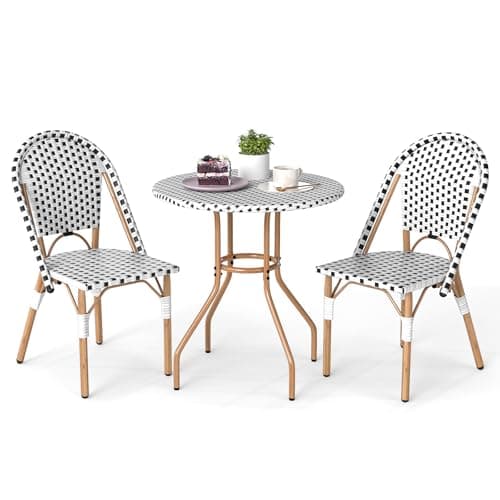 Tangkula Round Patio Dining Table SetLight enough to rearrange one-handed, which is the whole point of hollow tube. | The extruded case | 7.1 | $329.99 · View on Amazon #ad How we earn · Price as of November 2, 2026 |
| 3 | 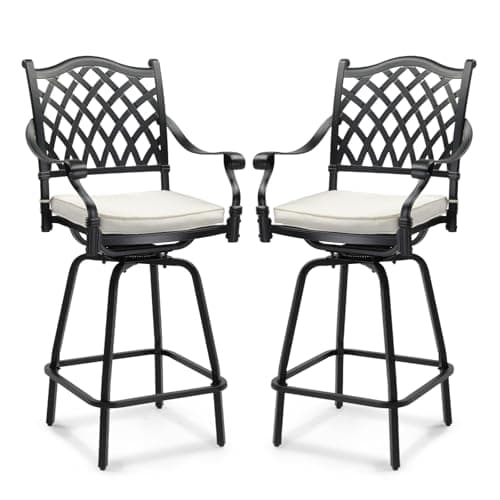 VINGLI Grid Back Cast Aluminum Swivel Bar Stools Set of 2Tall seating is where a light frame feels worst, and cast fixes it. | Where cast weight helps most | 7.7 | $199.99 · View on Amazon #ad How we earn · Price as of November 2, 2026 |
| 4 | 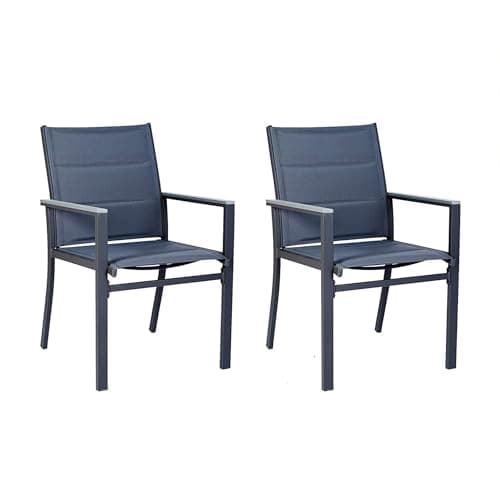 Kozyard Textilene Sling Patio Dining Chairs Set of 2A tensioned sling on a tube frame: the lowest-maintenance seat in the category. | Extruded, with no cushion at all | 6.9 | $129.99 · View on Amazon #ad How we earn · Price as of November 2, 2026 |
Scores are our own, assessed from published specifications, warranty terms and owner-reported outcomes — not from laboratory testing. Prices are shown live on Amazon; we never print a figure we cannot verify.
The question people actually type is "cast aluminum vs aluminum," which is a category error with a real question inside it. All patio aluminum is aluminum. What varies is how the aluminum was shaped: poured into a mold as a solid section, or pushed through a die as a hollow tube. Nothing about corrosion changes between them - aluminum does not rust either way, which is the single most useful fact in metal outdoor furniture. What changes is mass, wind behavior, what happens to water inside the frame, and where the piece eventually fails.
The short answer
Buy cast if the set lives somewhere windy, if you want chairs that feel planted rather than tinny, or if the seating is tall - bar stools and counter stools are where a light frame feels worst. Buy extruded if you rearrange the patio, need to stack or store chairs, or are buying a bigger set on a fixed budget, since hollow sections use less metal for the same footprint.
Then ignore the construction and look at the coating, because the coating is what actually ends the furniture. Cast and extruded both last decades as metal. The powder coat on top of either one is what chalks, fades and eventually lets go, and almost nobody in the consumer price bracket states what grade it is. That is the real buying criterion, and it is covered below and in more depth on the aluminum reference page.
What the two words actually mean
Cast aluminum is molten aluminum poured into a three-dimensional mold. Retailers in the category describe the result as "a solid aluminum meaning it is not hollow", formed by a mold and heavy enough that it "will not blow away during heavy storms." Because the shape comes from a mold, cast sections can carry scrollwork, lattice and relief patterns - which is why ornate traditional sets are almost always cast.
Extruded aluminum is billet pushed through a shaped die to produce a continuous hollow profile, then cut to length and assembled. The same retail source describes it as hollow and lightweight, ideal for stacking chairs for storage or moving and rearranging a set, and notes that extruded sets arrive in more pieces. Tube takes bends and welds easily, so extruded frames are usually plainer and more modern in shape.
The practical consequence is mass. A cast chair is in the ballpark of two to three times the weight of a comparable extruded one, and every difference below follows from that.
Side by side
The two constructions on the things that change a buying decision
| Cast aluminum | Extruded aluminum | |
|---|---|---|
| How it is shaped | Molten metal poured into a 3D mold; solid sections | Billet pushed through a die; hollow profile |
| Rust risk | None - aluminum does not rust | None - aluminum does not rust |
| Weight | Heavy; stays put in wind without anchoring | Light; moves in a gust, easy to carry |
| Water inside the frame | No cavity, so nothing to collect | Hollow sections can hold water; drain holes matter |
| Design vocabulary | Ornate, scrolled, traditional, relief patterns | Plain tube, modern, bent and welded shapes |
| Storage | Awkward to move; usually left out | Stacks and nests; easy to store |
| Repair | Touch-up paint; cracked castings cannot be welded at home | Touch-up paint; dented tube stays dented |
| Where it fails | Coating wear, then chipping at edges | Coating wear, then fastener holes and crimped joints |
| Typical price for the same footprint | Higher - more metal per piece | Lower - less metal per piece |
Construction properties are general to the two processes. Prices move constantly and are shown live on the picks above rather than written into this text.
The alloy question nobody asks
Extruded furniture is made from the 6000-series alloys, and the two that dominate architectural extrusion are 6061 and 6063. They are close relatives - almost identical in composition and mechanical properties - but they differ in ways that map neatly onto furniture.
- 6061 is harder. Typical Brinell hardness is given as 95, against 73 for 6063, and 6061-T6 carries higher yield and fatigue strength than 6063-T6. It is described as the preferred material for structural applications such as braces and frames.
- 6063 resists corrosion better and finishes better. It is rated the more corrosion-resistant of the pair and the more extrudable, takes decorative finishes well, and is common enough in building products to be called architectural aluminum.
Why it matters to you: almost no consumer furniture listing names its alloy, so this is not a spec you can shop on. What it does tell you is that the metal is rarely the weak link in either construction. A 6063 tube frame sitting in coastal air is not the thing that gives up first. The coating is, and after that the fasteners - which is why the 304 versus 316 stainless distinction matters more on a set than whether its frame was cast or extruded. The molybdenum in 316 is what stabilizes the passive layer against chloride pitting, which is the failure you get near the coast or beside a pool.
Hollow tube and the freeze problem
This is the one genuine durability difference, and it is specific to extruded frames. A hollow profile is a container. Rain enters through fastener holes, unsealed tube ends and the gaps around glides, and unless the frame has working drain holes at the bottom, it sits there. The same retail source that explains the two constructions recommends winter storage for extruded furniture specifically to prevent water from getting in and causing freeze damage.
The mechanism is simple: water expands as it freezes, and a sealed tube full of water has nowhere to put that expansion except outward. You see it as a split seam or a bulged section near a joint, usually in the spring, usually on a set that was fine in October. It is not common, but it is the one aluminum failure that is not a coating failure.
Two fixes, both free. Check that the bottom of each leg has an open drain path and clear it if it is blocked with grit - the same check we recommend for every tube frame on protecting patio furniture from rain. And if you store the set for winter, store it on its feet rather than upside down, so the drain holes point the way they were designed to. The winter storage page covers the order of operations.
Cast frames have no cavity, so none of this applies. That is the clearest single argument for cast in a freeze-thaw climate.
The coating decides the lifespan
Both constructions are powder-coated, and powder coating is a finishing process rather than a type of aluminum - a point the retail explainers make because the confusion is so common. The grade of that finish is the number that should decide your purchase, and the architectural industry already has a yardstick for it. The AAMA 2603 / 2604 / 2605 specifications describe three tiers of performance for coatings on aluminum, and the gap between them is not subtle: 2604 requires five years of natural weathering in South Florida while 2605 requires ten, with the resin content rising from around 50% fluoropolymer to 70%.
Consumer patio furniture is almost never sold against those specifications, which is the point. When a listing says "durable powder-coated finish" it is making a claim with no tier attached, and that is true whether the frame underneath was poured or extruded. So read the warranty instead: a brand that puts a published term on the finish is telling you something, and a brand that only puts a term on the frame is telling you something too. The full argument is on judging outdoor furniture quality.
One asymmetry worth knowing. Cast aluminum chips at edges and corners where the casting is proud, and a chip in a coating on aluminum is cosmetic rather than structural - there is no rust to creep underneath, which is exactly the opposite of what a chip means on steel. Extruded frames wear through at contact points instead: where a chair stacks against the one above it, where a glide meets the tube, and around fastener heads.
Most good sets are both
The cleanest framing is that this is not a binary. Mid-market and better sets routinely mix the two processes to get the advantages of each: the retail explainer cites Hanamint using lightweight extruded aluminum legs and arms with cast aluminum seats and backs, putting the mass where someone sits and the lightness where someone lifts.
That matters when you are reading a listing. "Cast aluminum dining set" often means cast chairs on an extruded table frame, or cast decorative panels on a tube structure. If the distinction is load-bearing for you - because of wind, or because you want to carry the chairs - find the section of the listing that describes each component rather than trusting the headline. The same trap, with a worse outcome, runs through mixed metal sets: an aluminum table paired with steel chairs. We take that apart on metal patio dining sets.
How to choose
Work through it in this order:
- Is the site windy? Open deck, lake frontage, rooftop, anywhere a fresh breeze is normal - go cast, or plan to weight extruded furniture. Anything from Beaufort force 5 upward moves light patio furniture, and that is an ordinary breezy afternoon rather than a storm. Our wind page covers the rest.
- Will you move the furniture? If chairs get carried in, stacked, or rearranged for guests, extruded wins outright and you will be glad of it weekly.
- Does it freeze where you live? Cast has no cavity to trap water. If you buy extruded, verify the drain path.
- What does the warranty cover - frame, finish, or both? This is the question that actually separates a ten-year set from a three-year one, regardless of construction.
- How hot does it get? Both constructions get hot in direct sun, and cast holds the heat longer because there is more metal to hold it. If that is a deciding factor, read patio furniture for hot weather before committing.
If the trade-offs on both sides sound like work, the third option is to leave metal behind entirely: HDPE poly lumber has no coating to fail and no cavity to fill, which is the case we make on the poly lumber page and against teak on POLYWOOD vs teak. It is also the surface that asks least of you week to week, which is the ranking on easy-to-clean patio furniture.
The picks in full
Each entry states what the product is, how it scores on our five criteria, what it gives up, and how the pick was made.
1. The cast case
Tangkula 5-Piece Cast Aluminum Outdoor Dining Set
Tangkula · Score 7.5/10
Cast aluminum is the quiet right answer for a small dining set: it cannot rust, and the weight problem solves itself.
Key specifications
- Cast aluminum frame and chairs
- Powder-coated finish
- Four chairs and a table
- No cushions required
How it scores
- Fade resistance
- 7.5
- Rust and corrosion
- 9.0
- Wind and stability
- 7.5
- Build and hardware
- 7.5
- Warranty strength
- 5.5
What works
- Aluminum does not rust — the single biggest failure mode in metal furniture is gone
- Cast sections are heavy enough to stay put without being immovable
- Powder coat is repairable with touch-up paint
The trade-offs
- The surface gets hot in direct sun
- Powder-coat grade is rarely stated, so coating life is the unknown
- Cast aluminum chips if something hard hits an edge
#ad How we earn · Price as of November 2, 2026
Selected on published specification, warranty terms and owner-reported outcomes; not personally tested.
2. The extruded case
Tangkula Round Patio Dining Table Set
Tangkula · Score 7.1/10
Round tables seat more people in less space than rectangles, and this is the affordable aluminum version of that argument.
Key specifications
- Aluminum frame with powder-coated finish
- Round top, umbrella hole standard
- Four to six seats
- No rust-capable structural steel
How it scores
- Fade resistance
- 7.0
- Rust and corrosion
- 8.5
- Wind and stability
- 6.5
- Build and hardware
- 7.0
- Warranty strength
- 5.0
What works
- Round geometry suits small square patios far better than a rectangle
- The umbrella hole is centered, which is where a round table wants it
- Aluminum frame means no rust
The trade-offs
- Lighter than cast aluminum, so it moves in wind
- Coating grade unstated
#ad How we earn · Price as of November 2, 2026
Selected on published specification, warranty terms and owner-reported outcomes; not personally tested.
3. Where cast weight helps most
VINGLI Grid Back Cast Aluminum Swivel Bar Stools Set of 2
VINGLI · Score 7.7/10
Cast aluminum is the metal answer at a bar: heavy enough to stay put, and structurally incapable of rusting the way a steel stool does.
Key specifications
- Cast aluminum frame and seat
- 360-degree swivel seat
- Bar height, sold as a pair
- Open grid seat and back, so nothing holds water
How it scores
- Fade resistance
- 7.0
- Rust and corrosion
- 9.0
- Wind and stability
- 8.0
- Build and hardware
- 7.5
- Warranty strength
- 5.0
What works
- Aluminum cannot rust, which removes the main failure mode of an outdoor stool
- Cast frames are far heavier than tube frames, so they stay where you put them
- Swivel makes a high seat much easier to get into and out of
- No cushion in the standard configuration, so nothing has to come indoors
The trade-offs
- Coating specification is not published, so long-run fade behavior is unknown
- A bare metal seat is hot in direct afternoon sun and cold in spring
- Swivel bearings are a moving part outdoors and the listing does not say how they are sealed
#ad How we earn · Price as of November 2, 2026
Selected on published specification, warranty terms and owner-reported outcomes; not personally tested.
4. Extruded, with no cushion at all
Kozyard Textilene Sling Patio Dining Chairs Set of 2
Kozyard · Score 6.9/10
A seat with nothing in it to soak up water: an extruded aluminum frame with a tensioned textilene sling, which is the lowest-maintenance way to sit outdoors.
Key specifications
- Extruded aluminum frame, listed as rust-resistant
- Padded textilene sling seat and back
- Listing describes the sling as breathable and quick-drying
- Sold as a pair
How it scores
- Fade resistance
- 6.5
- Rust and corrosion
- 8.5
- Wind and stability
- 6.0
- Build and hardware
- 6.5
- Warranty strength
- 4.5
What works
- No cushion means nothing to bring in, store or replace
- A sling dries in minutes rather than days, so rain is a non-event
- Light enough to move one-handed, which is the point of a tubular frame
- Hoses clean - dirt sits on the surface of the mesh rather than inside a filling
The trade-offs
- A sling is the component that fails: the fabric goes slack and brittle before the frame does
- Light frames move in wind, which is the trade for carrying them easily
- Sling replacement is a specialist job and almost never offered by budget brands
- Less supportive than deep-seat cushions over a long dinner
#ad How we earn · Price as of November 2, 2026
Selected on published specification, warranty terms and owner-reported outcomes; not personally tested.
Common questions
What is the difference between cast aluminum and regular aluminum patio furniture?
Is cast aluminum patio furniture better than extruded?
Does extruded aluminum patio furniture rust?
Which aluminum alloy is used in patio furniture?
Can you tell cast from extruded by looking at it?
Does cast aluminum patio furniture crack?
Sources
- The Difference Between Cast Aluminum and Extruded Aluminum Patio Furniture — SKH (Sun, Kitchen and Home). Checked 2026-10-29.
Retailer description of the two constructions: cast as solid and mold-formed rather than hollow, extruded as hollow and lightweight with winter storage recommended to prevent water getting in and causing freeze damage, plus the Hanamint hybrid of extruded legs and arms with cast seats and backs.
- Grade Guide: Aluminum 6061 vs 6063 — Metal Supermarkets. Checked 2026-10-29.
The two extrusion alloys behind most outdoor metal furniture: 6061 at a typical 95 Brinell against 6063 at 73, 6063 rated the more corrosion-resistant and the more extrudable of the pair, and 6061 described as the more robust choice in most extrusion configurations.
- AAMA Paint Specifications — Linetec. Checked 2026-09-23.
The AAMA 2603 / 2604 / 2605 architectural finish tiers used as the yardstick for what a powder coat on aluminum is actually rated to do.
- Understanding AAMA 2604 vs. AAMA 2605 — AMICO Architectural Metals. Checked 2026-09-23.
The South Florida natural-weathering requirement behind each tier — 5 years for 2604, 10 years for 2605 — and the 50% vs 70% fluoropolymer resin difference.
- 304 vs 316 Stainless Steel Screws — SFS USA. Checked 2026-09-23.
Why 316 fasteners resist chloride pitting and 304 do not: the 2-3% molybdenum addition that stabilizes the passive layer.
- Beaufort Wind Chart — Estimating Wind Speeds — National Weather Service (NOAA). Checked 2026-09-23.
Wind-speed bands and their observable effects, used instead of manufacturer wind claims we cannot verify.
Read next
More from Materials
Five materials, five very different outcomes after five summers. Start here if you are choosing.