Guide
Can patio furniture be left outside all year?
For some materials the answer is genuinely yes. For the soft parts it is almost always no.
How this page is funded: Deck & Dusk earns a commission when you buy through the Amazon links below, at no extra cost to you. Commission never decides a ranking — our picks and our criteria are set before any link is added. Read the full disclosure.
Quick picks
If your goal is furniture you never have to move, these are the pieces that genuinely do not care what the season is.
| # | Product | Best for | Score | Price |
|---|---|---|---|---|
| 1 | 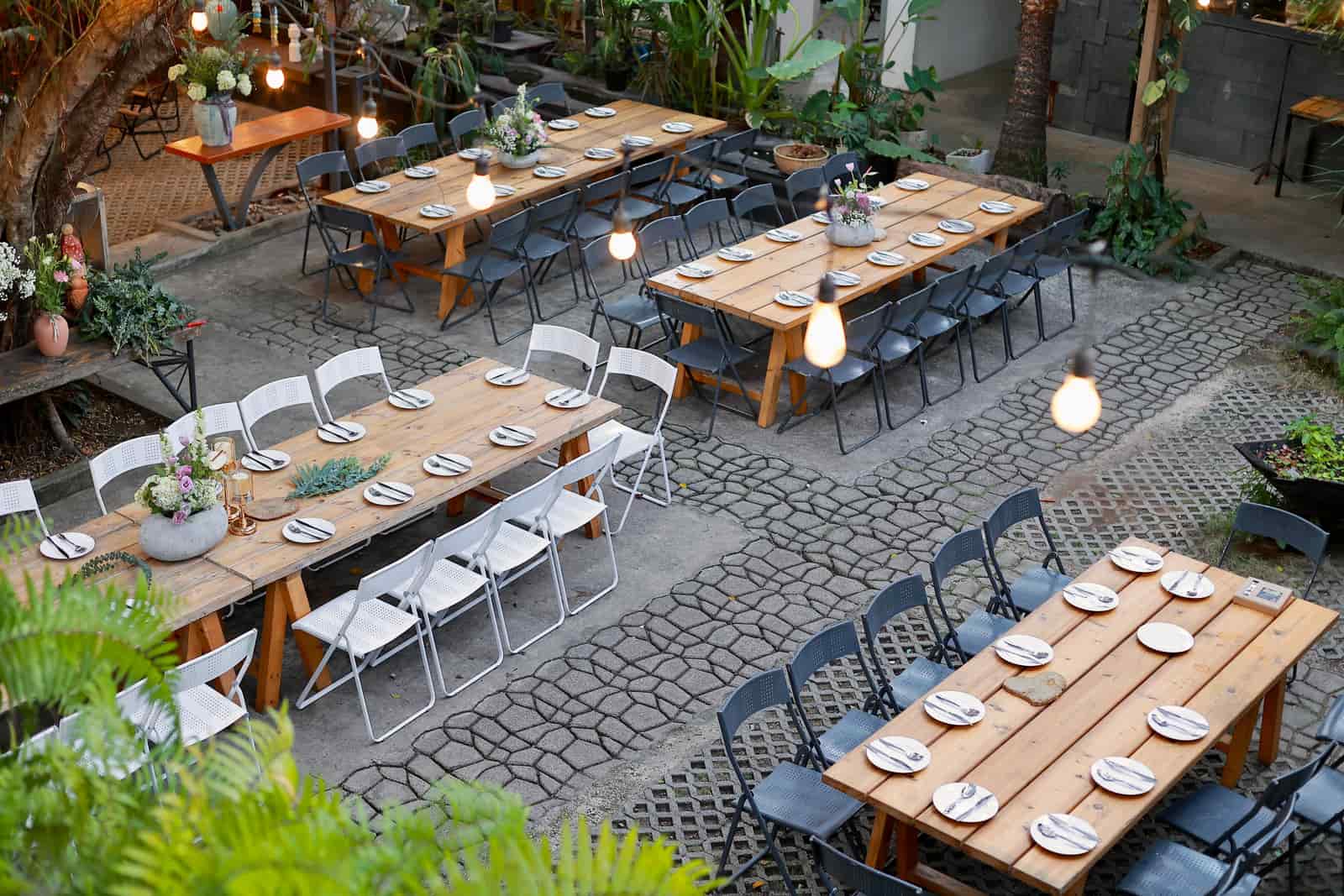 POLYWOOD Nautical 7-Piece Dining SetNo water absorption, no rust path, no finish to lift. | A set that overwinters where it stands | 9.3 | Check price on Amazon #ad How we earn · Live price at Amazon |
| 2 | 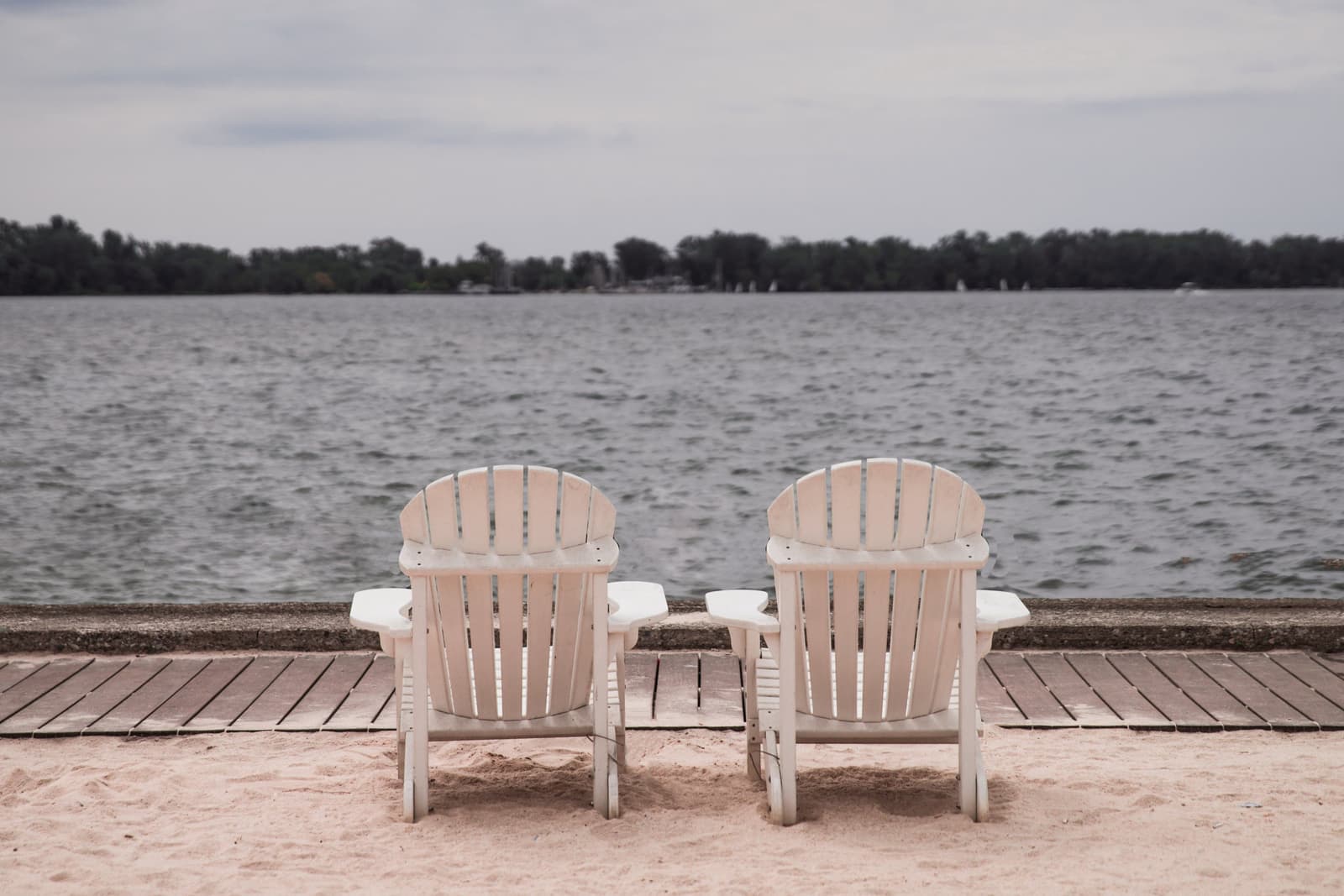 POLYWOOD Classic Adirondack ChairFreeze-thaw has nothing to work on. | Seating that stays out | 9.3 | Check price on Amazon #ad How we earn · Live price at Amazon |
| 3 | 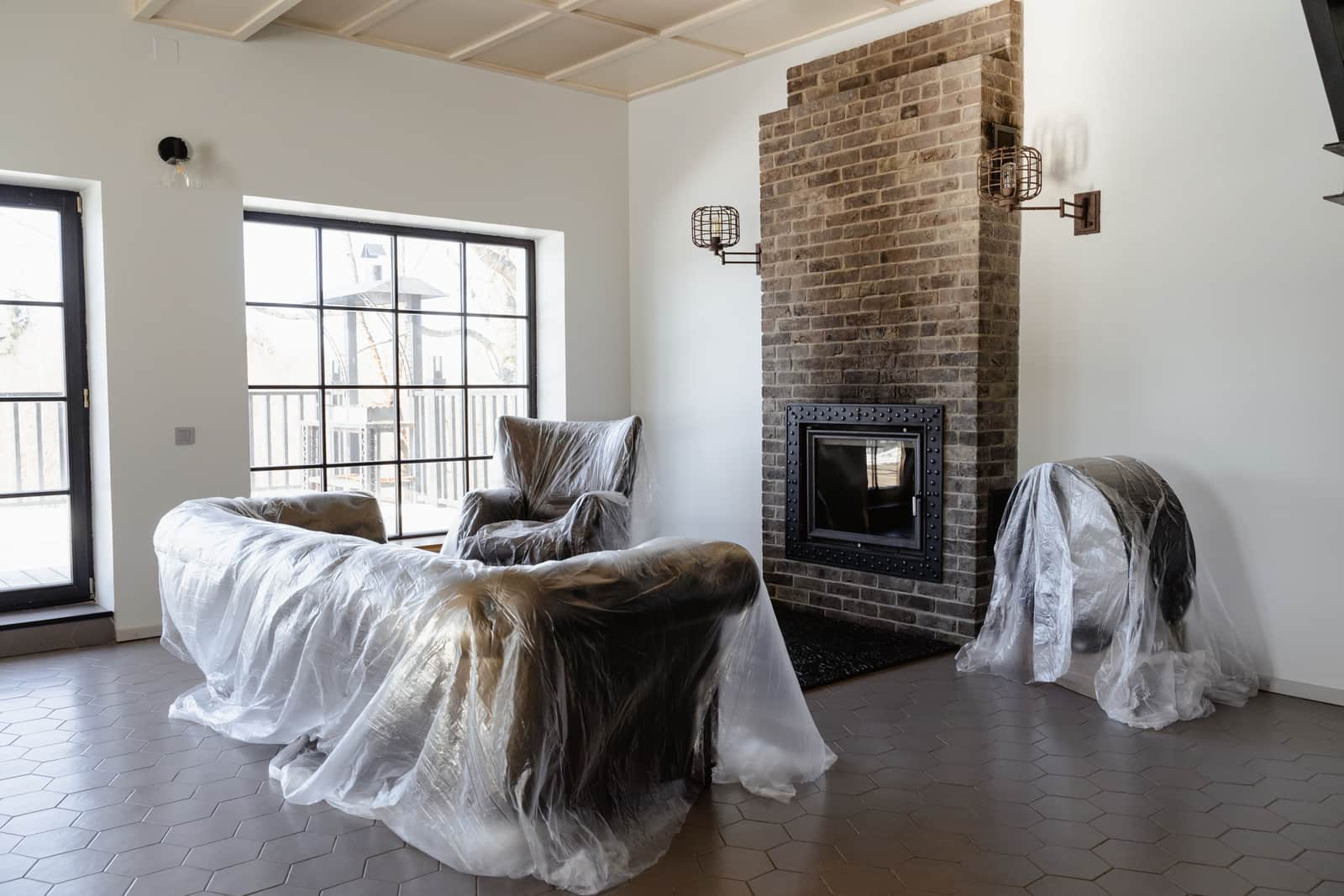 Classic Accessories Ravenna Patio Furniture CoverVented and strapped — the two things that make a cover help rather than harm. | Everything that does need covering | 8.1 | Check price on Amazon #ad How we earn · Live price at Amazon |
| 4 | Vailge Heavy-Duty Patio Sofa CoverPVC-coated and fully waterproof, for climates where resistance is not enough. | Genuinely wet winters | 7.7 | Check price on Amazon #ad How we earn · Live price at Amazon |
Scores are our own, assessed from published specifications, warranty terms and owner-reported outcomes — not from laboratory testing. Prices are shown live on Amazon; we never print a figure we cannot verify.
This is one of the most-asked questions in the category and it has a genuinely different answer depending on what the furniture is made of. The short version: most frames can stay out, most soft goods cannot, and the mistakes that cost people money are nearly always about the soft goods.
The answer by material
| Material | Leave out all year? | Why |
|---|---|---|
| HDPE poly lumber | Yes, uncovered | Absorbs no water, cannot rust, no finish to lift. Freeze-thaw has nothing to act on. |
| Teak | Yes, uncovered | Heartwood resists decay without treatment. It will gray; that is cosmetic. |
| Cast aluminum | Yes, cover optional | No rust path. A cover mainly protects the powder coat from abrasion and grit. |
| All-weather HDPE wicker (aluminum frame) | Yes, but cover it | Frame is fine; UV and grit are what age the weave. Covering extends it noticeably. |
| Acacia / eucalyptus | No — cover or store | Absorbs water, then freeze-thaw opens the grain. This is where checking starts. |
| Powder-coated steel | No — cover, and inspect in spring | Every winter is months of continuous moisture on any coating breach. |
| Cushions | No — bring indoors | Foam holds water, then mildews. Even quick-dry foam does not want a winter of it. |
| Umbrella canopies | No — close, remove, store | Wind is the risk, not water. A stored canopy is also a canopy that is not fading. |
| Glass table tops | No — store flat or remove | Freeze-thaw on an edge chip is how tempered glass fails spontaneously. |
What freeze-thaw actually does
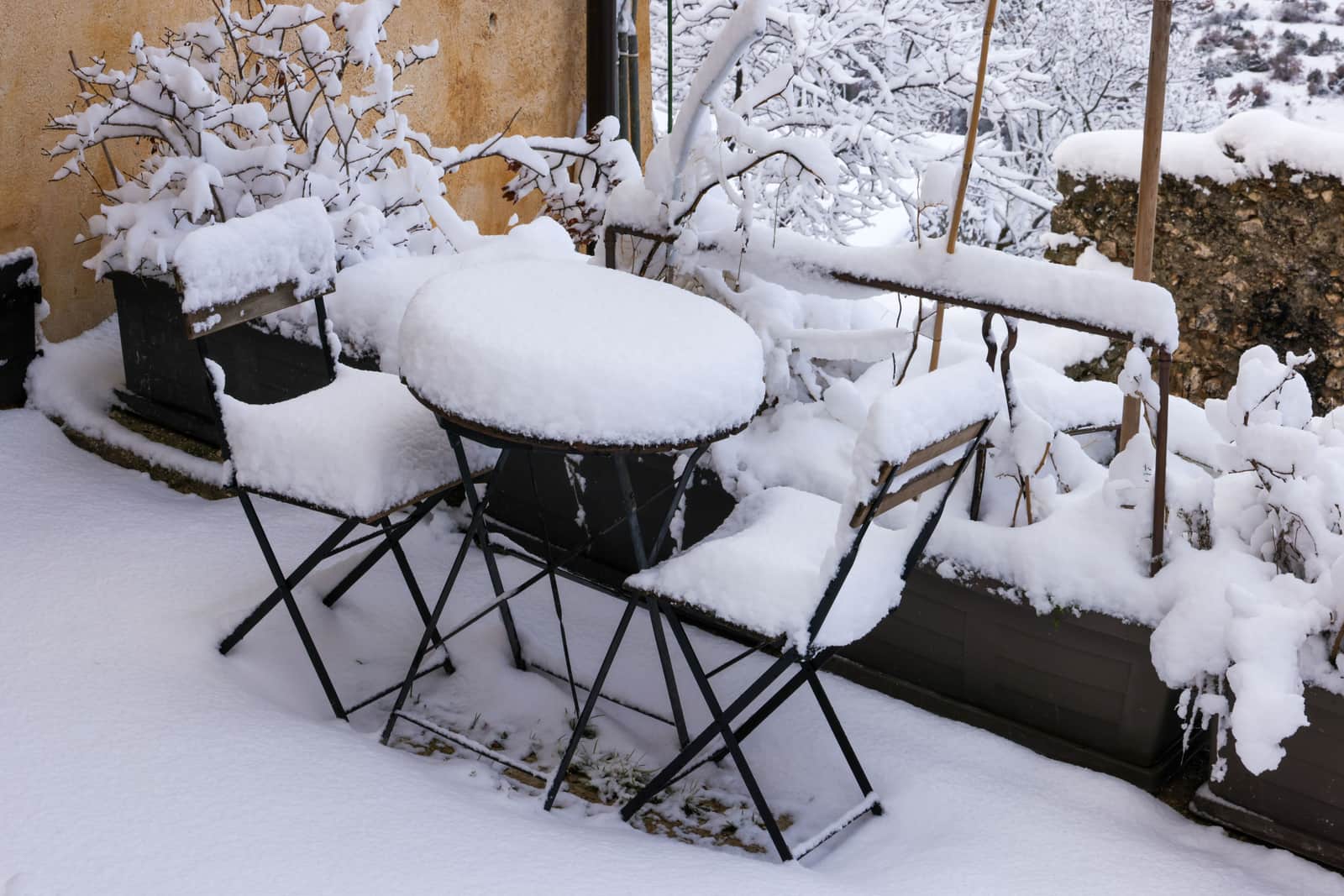
Water expands about 9% when it freezes. Anywhere water has gotten into a material or a joint, that expansion is a wedge working from the inside, and it repeats every time the temperature crosses freezing — which in most of the US is dozens of times per winter, not once.
In wood, water sits in the cell structure and in any check or crack. Each freeze widens the crack slightly, which admits more water next time. That is the mechanism behind a wooden chair that looks fine in November and has visible splitting along the grain in March.
In coated steel, water sits under any coating breach. Freezing lifts the coating further, exposing more steel. In cushion foam, water sits in the cell structure and freezing ruptures cell walls, which is why a cushion that overwintered outside never feels the same afterward even once it dries.
HDPE and aluminum are unaffected because neither admits water in the first place. That is the entire reason those two materials dominate every recommendation on this site.
What must come indoors, in priority order
- Cushions and pillows. Non-negotiable. They are the most expensive consumable on the patio and the most vulnerable to a winter outside. A garage, a shed, a deck box, or stacked in a spare room — anywhere dry.
- Umbrella canopies. Close and remove. An umbrella left open through a winter storm is the single most common total loss in this category, and a stored canopy also gains a season of color life.
- Glass tops. If they detach, store them flat and off the ground. If they do not, cover the table and never let ice load sit on the middle of an unsupported pane.
- Anything with a mechanism. Folding chairs, reclining loungers, crank handles. Moving parts plus moisture plus freezing is how mechanisms seize.
If you have no storage at all
Apartment balconies, small yards, no garage — a real constraint, and there are real answers:
- Buy furniture that does not need storing. An HDPE bistro set on a balcony is a genuinely maintenance-free object. This is the strongest argument for paying more up front in a small space.
- A deck box solves cushions. It is the cheapest single purchase that removes the biggest winter problem, and it doubles as a seat.
- Stack and strap. Nesting chairs on top of a table, covered and strapped, keeps them off standing water and reduces the surface presenting to wind.
- Get it off the ground. Feet sitting in a frozen puddle for four months is worse than everything else on this list combined. Slabs, blocks, anything.
The full sequence, including when to do each step, is in our winter storage guide.
The picks in full
Each entry states what the product is, how it scores on our five criteria, what it gives up, and how the pick was made.
1. A set that overwinters where it stands
POLYWOOD Nautical 7-Piece Dining Set
POLYWOOD · Score 9.3/10
The dining set you buy once. Everything that normally fails on an outdoor table — finish, fasteners, glass — has been engineered out.
Key specifications
- HDPE lumber table and chairs
- Marine-grade stainless hardware
- Umbrella hole on most table configurations
- 20-year residential lumber warranty
How it scores
- Fade resistance
- 9.5
- Rust and corrosion
- 9.5
- Wind and stability
- 9.0
- Build and hardware
- 9.0
- Warranty strength
- 9.5
What works
- No glass top to shatter and no veneer to lift
- Stays outside through winter without a cover if you want it to
- Hoses clean after a meal
The trade-offs
- Very heavy — a seven-piece set is a two-person job
- Costs several times a comparable acacia set
#ad How we earn · Live price at Amazon
Selected on published specification, warranty terms and owner-reported outcomes; not personally tested.
2. Seating that stays out
POLYWOOD Classic Adirondack Chair
POLYWOOD · Score 9.3/10
The reference HDPE Adirondack: color compounded through the lumber, a 20-year residential warranty, and nothing on it to rust or splinter.
Key specifications
- 100% HDPE lumber, color and UV inhibitors compounded through the material
- Marine-grade stainless hardware
- 20-year residential lumber warranty
- Arrives flat-packed; bolt-together assembly
How it scores
- Fade resistance
- 9.5
- Rust and corrosion
- 9.5
- Wind and stability
- 8.5
- Build and hardware
- 9.0
- Warranty strength
- 9.5
What works
- Fade behavior is a material property here, not a surface coat that can wear off
- Warranty language explicitly covers splintering, cracking, chipping, peeling and rot
- Heavy enough to stay put on a gusty evening
- Washes clean with soap and water — no sealing, oiling or refinishing, ever
The trade-offs
- Costs multiples of a big-box resin chair, and the value only shows up over years
- Heavy to move around a deck on your own
- Sanding it voids the warranty, so deep scratches stay
#ad How we earn · Live price at Amazon
Selected on published specification, warranty terms and owner-reported outcomes; not personally tested.
3. Everything that does need covering
Classic Accessories Ravenna Patio Furniture Cover
Classic Accessories · Score 8.1/10
The cover that does the two things cheap covers skip: it vents, and it has enough structure to shed water instead of pooling it.
Key specifications
- Woven polyester fabric with a water-resistant backing
- Air vents to reduce condensation
- Elastic hem with click-close straps
- Padded handles for fitting and removal
How it scores
- Fade resistance
- 7.5
- Rust and corrosion
- 9.0
- Wind and stability
- 8.0
- Build and hardware
- 8.5
- Warranty strength
- 7.0
What works
- Vents matter more than waterproofing — a sealed cover traps moisture and grows mildew
- Straps stop the cover becoming a sail in the first storm
- Size ranges actually fit real furniture dimensions
The trade-offs
- Costs several times a generic cover
- Still needs the furniture dry before you cover it
#ad How we earn · Live price at Amazon
Selected on published specification, warranty terms and owner-reported outcomes; not personally tested.
4. Genuinely wet winters
Vailge Heavy-Duty Patio Sofa Cover
Vailge · Score 7.7/10
Genuinely waterproof rather than water-resistant, because of a PVC coating — which is also its main trade-off.
Key specifications
- 600D polyester with a PVC coating
- Fully waterproof rather than water-resistant
- Air vents and tie-down straps
- Wide size range
How it scores
- Fade resistance
- 7.0
- Rust and corrosion
- 9.0
- Wind and stability
- 8.0
- Build and hardware
- 8.0
- Warranty strength
- 6.0
What works
- Keeps water out completely, which matters in a wet winter climate
- Heavy fabric resists tearing at corners
The trade-offs
- A fully sealed cover traps any moisture already underneath — dry the furniture first
- The PVC coating stiffens in freezing weather and can crack if handled cold
#ad How we earn · Live price at Amazon
Selected on published specification, warranty terms and owner-reported outcomes; not personally tested.
Common questions
Can you leave patio furniture outside in winter?
Does cold weather damage patio furniture?
Should I cover patio furniture in winter or bring it inside?
Can I leave my patio umbrella outside all year?
Sources
- POLYWOOD Limited Residential Warranty — POLYWOOD. Checked 2026-09-23.
The 20-year residential lumber warranty terms, including the splinter / crack / chip / peel / rot language and the sanding and painting exclusions.
- Sunbrella Warranty — Sunbrella (Glen Raven). Checked 2026-09-23.
Published warranty lengths: 5 years on upholstery and sling fabrics, 10 years on shade and marine fabrics, 3.5 years on recycled lines.
- 304 vs 316 Stainless Steel Screws — SFS USA. Checked 2026-09-23.
Why 316 fasteners resist chloride pitting and 304 do not: the 2-3% molybdenum addition that stabilizes the passive layer.
Read next
More from Durability & Lifespan
Lifespan by material, the three failure modes that end most patio sets, and how to read a warranty.