Materials
The best metal for outdoor furniture
One metal protects itself as it corrodes. The others depend on a coating, and coatings get chipped.
How this page is funded: Deck & Dusk earns a commission when you buy through the Amazon links below, at no extra cost to you. Commission never decides a ranking — our picks and our criteria are set before any link is added. Read the full disclosure.
Quick picks
Ranked by how the metal behaves once its finish is breached, because every outdoor finish is eventually breached. Cast aluminum leads, extruded aluminum follows, steel comes last and carries a condition.
| # | Product | Best for | Score | Price |
|---|---|---|---|---|
| 1 | 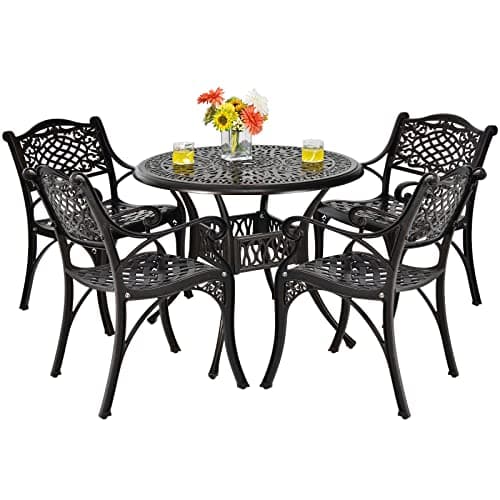 Tangkula 5-Piece Cast Aluminum Outdoor Dining SetCast aluminum: heavy enough to stay put, and nothing in it can rust through. | Best overall metal | 7.5 | $529.99 · View on Amazon #ad How we earn · Price as of October 11, 2026 |
| 2 | No image Tangkula Round Patio Dining Table SetLighter and cheaper than cast, with the same corrosion story and less mass. | Best extruded aluminum | 7.1 | Check price on Amazon #ad How we earn · Live price at Amazon |
| 3 | No image Yardbird Harriet Outdoor Wicker SectionalThe frame is the metal decision on wicker furniture, and this one states aluminum. | Best aluminum-framed seating | 8.7 | Check price on Amazon #ad How we earn · Live price at Amazon |
| 4 | 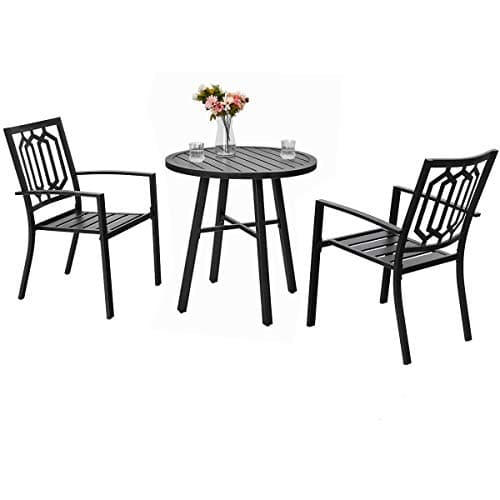 PHI VILLA 3-Piece Outdoor Bistro SetBuy it knowing the coating is the whole warranty, and plan to touch it up. | Steel, if the budget decides it | 5.5 | $253.99 · View on Amazon #ad How we earn · Price as of October 11, 2026 |
Scores are our own, assessed from published specifications, warranty terms and owner-reported outcomes — not from laboratory testing. Prices are shown live on Amazon; we never print a figure we cannot verify.
The short answer
The best metal for outdoor furniture is aluminum, and it is not a close contest. Aluminum and steel both corrode outdoors; the difference is what the corrosion then does. Aluminum oxide is a tight, adherent skin that seals the metal underneath, so the corrosion stops itself. Steel oxide — rust — flakes off and exposes fresh metal, so the corrosion feeds itself until the tube is holed. Almost everything else about buying metal patio furniture is a detail hanging off that one fact. Our aluminum reference page carries the full material profile; this page is the choice between the metals.
Why aluminum wins: the oxide
Aluminum reacts with air almost instantly and forms a thin layer of aluminum oxide. That layer is dense, it bonds to the metal, and it re-forms the moment it is scratched. The practical consequence on a deck is that bare aluminum exposed by a chip goes dull gray and then stops. It does not spread, it does not stain the boards underneath, and it does not eat through the wall of the tube.
Iron oxide does the opposite. It occupies more volume than the metal it came from, so it lifts, cracks and sheds, which keeps presenting new steel to the weather. Give it a winter of trapped moisture inside a tube and the failure arrives from the inside, where nobody looks. That is the most common way a budget metal set actually dies: not a broken weld, a rusted-through leg.
Three rules follow from the oxide difference, and between them they cover most buying decisions:
- On aluminum, a chip is cosmetic. Touch it up when convenient.
- On steel, a chip is structural. Touch it up the week you find it. The sequence is on our rust guide.
- On any metal, fasteners and welds are the weak points, because that is where the coating is thinnest and where water collects.
Cast vs extruded aluminum
Once you have settled on aluminum there is a second decision, and it is about mass and shape rather than corrosion. Both forms are the same metal with the same oxide behavior, so neither choice costs you durability.
The two ways aluminum furniture is made
| Cast aluminum | Extruded aluminum | |
|---|---|---|
| How it is made | Molten aluminum poured into a mold, one part at a time | Aluminum pushed through a die as a hollow profile, then cut and joined |
| Weight | Heavy - solid sections, substantial in the hand | Light - hollow tube, easy to carry one-handed |
| Wind behavior | Stays where you put it | Moves in a gust unless the set is large or loaded |
| Detail possible | Ornate scrollwork and molded pattern | Straight lines and simple curves |
| Repairability | A cracked casting is effectively unrepairable | A bent tube can often be straightened or replaced |
| Typical cost | Higher for the same seat count | Lower - the cheapest credible metal furniture is extruded |
Listings often say only 'aluminum'. The shipping weight is the giveaway: a cast four-seat dining set is dramatically heavier than an extruded one of the same size.
Pick cast if the deck is exposed and you are tired of chasing chairs, or if you want the traditional look. Pick extruded if you rearrange the patio, carry things up steps, or want the lowest honest entry price into metal.
Steel and wrought iron
Steel earns its place in one situation: when the budget sets the material and you accept the maintenance. It is strong, it is cheap, and a well-coated steel bistro set on a covered porch can last many years. Put the same set on an open deck in a wet climate and the coating is doing a job it was not designed for.
Wrought iron is a separate case, and worth being precise about because the term is used loosely. Genuine wrought iron is heavy, solid-section and often decades old; it rusts freely and is maintained by sanding and repainting, which owners of real pieces simply accept. Most furniture sold new as wrought iron is tubular steel with a decorative profile, and it rusts the way tubular steel rusts — from inside the tube. Our steel and wrought iron reference covers both, and steel vs aluminum is the direct head-to-head if that is the decision in front of you.
Stainless is hardware, not frames
Stainless steel almost never appears as a furniture frame at consumer prices. It appears as fasteners, and that is where it matters most. Two grades are worth knowing: 304, also sold as 18-8, is the standard outdoor stainless and resists general corrosion well; 316 adds molybdenum, which is what stabilizes it against chloride pitting near salt water.
The useful thing to know is that "marine-grade stainless" in a furniture listing nearly always means 18-8 / 304, not 316. That is still good hardware. It is simply not the grade the phrase implies, and on a coastal site the gap matters — see our coastal salt air page.
The finish is the real spec
Because aluminum survives on its own, the finish on aluminum furniture governs how it looks in year eight rather than whether it is still standing. That is a fade-and-chalk question, and there is an architectural yardstick for it that the furniture industry largely ignores. The AAMA specifications set tiers for coatings on architectural aluminum: AAMA 2604 requires five years of South Florida natural weathering, AAMA 2605 requires ten, built on roughly 70% fluoropolymer resin against 50%.
Consumer patio furniture almost never states a tier. Treat an unstated coating as an unknown and price the furniture accordingly — which, given that aluminum does not fail structurally, mostly means expecting to repaint a cheap frame years before you would repaint an expensive one. The Yardbird warranty is one of the few in this category that separates frame coverage from finish coverage in writing, which is exactly the distinction this section is about.
How to buy metal furniture
Four checks, in order, all of which can be done from a product page:
- Find the word aluminum in the specification, not in the marketing copy. "Metal frame" and "powder-coated frame" both describe steel perfectly well, and sellers who have aluminum tend to say aluminum.
- Read the shipping weight. It separates cast from extruded faster than any description, and it tells you whether the set will move in wind.
- Check what the fasteners are. Stainless is the answer you want. Unstated usually means plated steel, which is the first thing to fail.
- On wicker and sling furniture, find the frame material. This is the metal decision hiding inside a non-metal purchase, and an unstated frame should be read as steel until the seller says otherwise.
The picks in full
Each entry states what the product is, how it scores on our five criteria, what it gives up, and how the pick was made.
1. Best overall metal
Tangkula 5-Piece Cast Aluminum Outdoor Dining Set
Tangkula · Score 7.5/10
Cast aluminum is the quiet right answer for a small dining set: it cannot rust, and the weight problem solves itself.
Key specifications
- Cast aluminum frame and chairs
- Powder-coated finish
- Four chairs and a table
- No cushions required
How it scores
- Fade resistance
- 7.5
- Rust and corrosion
- 9.0
- Wind and stability
- 7.5
- Build and hardware
- 7.5
- Warranty strength
- 5.5
What works
- Aluminum does not rust — the single biggest failure mode in metal furniture is gone
- Cast sections are heavy enough to stay put without being immovable
- Powder coat is repairable with touch-up paint
The trade-offs
- The surface gets hot in direct sun
- Powder-coat grade is rarely stated, so coating life is the unknown
- Cast aluminum chips if something hard hits an edge
#ad How we earn · Price as of October 11, 2026
Selected on published specification, warranty terms and owner-reported outcomes; not personally tested.
2. Best extruded aluminum
Tangkula Round Patio Dining Table Set
Tangkula · Score 7.1/10
Round tables seat more people in less space than rectangles, and this is the affordable aluminum version of that argument.
Key specifications
- Aluminum frame with powder-coated finish
- Round top, umbrella hole standard
- Four to six seats
- No rust-capable structural steel
How it scores
- Fade resistance
- 7.0
- Rust and corrosion
- 8.5
- Wind and stability
- 6.5
- Build and hardware
- 7.0
- Warranty strength
- 5.0
What works
- Round geometry suits small square patios far better than a rectangle
- The umbrella hole is centered, which is where a round table wants it
- Aluminum frame means no rust
The trade-offs
- Lighter than cast aluminum, so it moves in wind
- Coating grade unstated
#ad How we earn · Live price at Amazon
Selected on published specification, warranty terms and owner-reported outcomes; not personally tested.
3. Best aluminum-framed seating
Yardbird Harriet Outdoor Wicker Sectional
Yardbird · Score 8.7/10
The build most people mean when they say they want a patio set that lasts: aluminum frame, HDPE-based weave, performance fabric.
Key specifications
- Powder-coated aluminum frame
- HDPE-based all-weather wicker weave
- Performance fabric cushions
- 10-year frame warranty on premium pieces
How it scores
- Fade resistance
- 8.5
- Rust and corrosion
- 9.0
- Wind and stability
- 7.5
- Build and hardware
- 9.0
- Warranty strength
- 8.5
What works
- An aluminum frame cannot rust from the inside out the way a steel frame does
- HDPE weave is the only wicker type that survives real UV exposure
- Replacement cushions and parts are actually available
The trade-offs
- Premium pricing; this is a several-thousand-dollar category
- Cushions still need storing or covering off-season
#ad How we earn · Live price at Amazon
Selected on published specification, warranty terms and owner-reported outcomes; not personally tested.
4. Steel, if the budget decides it
PHI VILLA 3-Piece Outdoor Bistro Set
PHI VILLA · Score 5.5/10
Balcony-scale seating that does its job, made of the one material this site keeps warning about.
Key specifications
- Powder-coated steel frame
- Two chairs plus a small table
- Textilene or slat seat depending on model
- Compact footprint for balconies
How it scores
- Fade resistance
- 6.0
- Rust and corrosion
- 4.5
- Wind and stability
- 6.5
- Build and hardware
- 6.0
- Warranty strength
- 4.0
What works
- Fits where nothing else fits
- Inexpensive
- Heavy enough for a windy balcony
The trade-offs
- Steel: every chip in the powder coat becomes a rust bloom
- Small tables tip more easily than they look like they will
#ad How we earn · Price as of October 11, 2026
Selected on published specification, warranty terms and owner-reported outcomes; not personally tested.
Common questions
What is the best metal for outdoor furniture?
Is cast aluminum better than extruded aluminum for patio furniture?
Does aluminum patio furniture rust?
Is wrought iron patio furniture worth buying?
What stainless steel grade should outdoor furniture hardware be?
Sources
- AAMA Paint Specifications — Linetec. Checked 2026-09-23.
The AAMA 2603 / 2604 / 2605 architectural finish tiers used as the yardstick for what a powder coat on aluminum is actually rated to do.
- Understanding AAMA 2604 vs. AAMA 2605 — AMICO Architectural Metals. Checked 2026-09-23.
The South Florida natural-weathering requirement behind each tier — 5 years for 2604, 10 years for 2605 — and the 50% vs 70% fluoropolymer resin difference.
- 304 vs 316 Stainless Steel Screws — SFS USA. Checked 2026-09-23.
Why 316 fasteners resist chloride pitting and 304 do not: the 2-3% molybdenum addition that stabilizes the passive layer.
- Yardbird Outdoor Furniture Warranty — Yardbird. Checked 2026-09-24.
Published cover by component — 10 years on aluminum, teak and HDPE poly frames, 5 years on the aluminum finish, 3 years on the HDPE wicker weave and 1 year on cushions.
Read next
More from Materials
Five materials, five very different outcomes after five summers. Start here if you are choosing.