Material
Acacia outdoor furniture
Harder than teak, and nothing like as durable. Both of those are true, and hardness is not the reason.
How this page is funded: Deck & Dusk earns a commission when you buy through the Amazon links below, at no extra cost to you. Commission never decides a ranking — our picks and our criteria are set before any link is added. Read the full disclosure.
Quick picks
Acacia is a sound purchase at its price, provided you buy the maintenance with it. These are the sets worth owning and the two products that decide how long they last.
| # | Product | Best for | Score | Price |
|---|---|---|---|---|
| 1 | 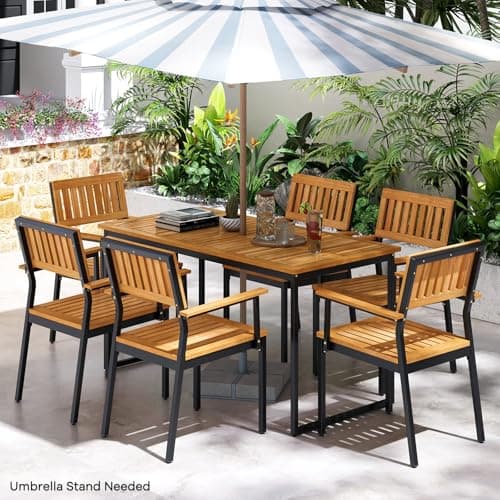 Tangkula 7-Piece Acacia Wood Patio Dining SetSeats six in solid hardwood at a price aluminum does not reach. | Most acacia for the money | 6.0 | $434.99 · View on Amazon #ad How we earn · Price as of October 15, 2026 |
| 2 | 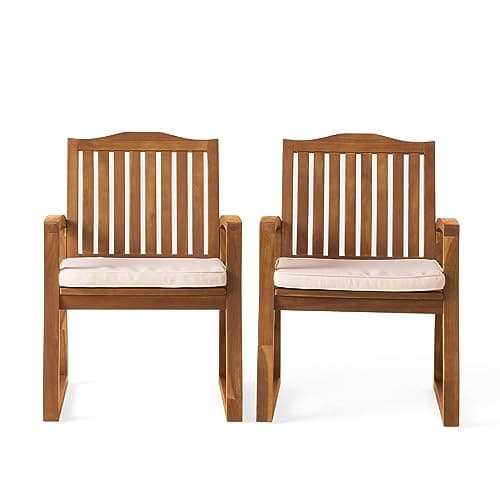 Christopher Knight Home Della Acacia Dining SetBetter proportioned than the price suggests; same finish schedule. | Acacia at four to six seats | 6.0 | $189.99 · View on Amazon #ad How we earn · Price as of October 15, 2026 |
| 3 | 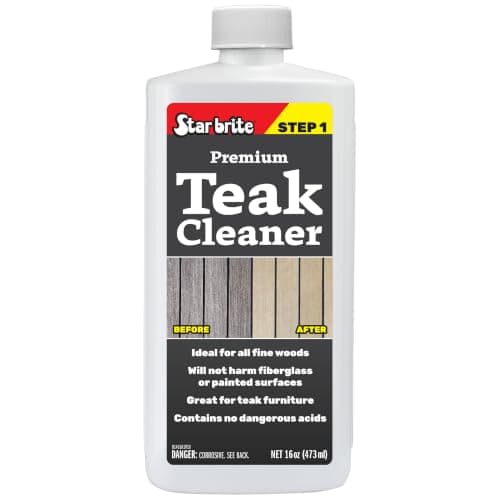 Star brite Premium Outdoor Teak CleanerChemical cleaning removes far less wood than sanding does. | Bringing gray acacia back | 7.5 | $13.59 · View on Amazon #ad How we earn · Price as of October 15, 2026 |
| 4 | 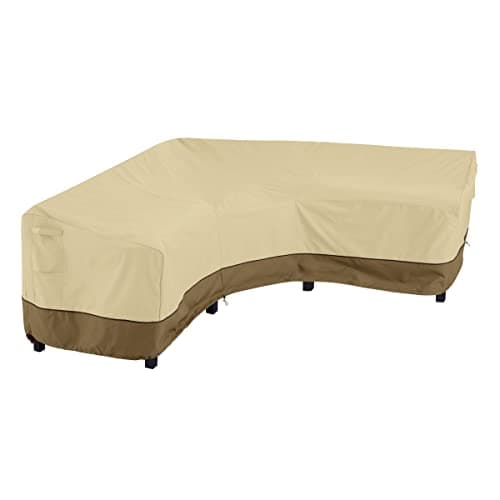 Classic Accessories Veranda Patio Furniture CoverCovering is optional on teak. On acacia it is part of the product. | The thing acacia genuinely needs | 7.3 | $114.66 · View on Amazon #ad How we earn · Price as of October 15, 2026 |
Scores are our own, assessed from published specifications, warranty terms and owner-reported outcomes — not from laboratory testing. Prices are shown live on Amazon; we never print a figure we cannot verify.
What acacia actually is
Start with the uncomfortable part: "acacia" on a furniture listing does not name a material. It names a genus of roughly a thousand species, and the density across that genus is greatly variable — some species lighter than black cherry, others among the heaviest and hardest woods on earth. The genus has even been formally split into five genera in a recent taxonomic ruling, so a plank sold as acacia in 2026 may not botanically be an Acacia at all.
In practice, the overwhelming majority of acacia patio furniture is Acacia mangium, a fast-growing plantation species farmed across Southeast Asia, with some Acacia auriculiformis and hybrids of the two. That is the wood this page is about, because that is the wood in the box. A listing that names a species at all is doing better than most; almost none do.
Hardness is not durability
Acacia is marketed on hardness, and the hardness is real. Acacia mangium measures 1,430 lbf on the Janka scale at an average dried weight of 36.5 lbs per cubic foot. That is a genuinely hard, dense wood. It resists denting, it holds a crisp machined edge, and it feels substantial under your hand in a way a pine or a thin eucalyptus does not.
Here is the number that reframes the entire category. Teak measures 1,070 lbf — noticeably softer than acacia — and the same reference rates teak heartwood very durable against decay. Acacia mangium is the harder wood, and its rot-resistance entry reads no data available.
Hardness against decay resistance, from the same reference
| Wood | Janka hardness | Published rot resistance |
|---|---|---|
| Acacia mangium (plantation acacia) | 1,430 lbf | No data available |
| Teak (Tectona grandis) heartwood | 1,070 lbf | Very durable |
Two independent properties. Hardness describes resistance to denting. Decay resistance describes what happens when fungi arrive, and it comes from extractive chemistry inside the heartwood rather than from density.
Those properties are not related, and conflating them is the most common mistake in this part of the market. Hardness tells you how the wood survives a dropped plate. Decay resistance tells you how it survives November. The USDA Forest Products Laboratory is explicit that decay resistance lives in the heartwood of species that carry it, and that sapwood is non-durable in every species. Fast-grown plantation stock carries a high proportion of sapwood and juvenile wood by definition, because that is what fast growth produces.
So the honest statement about acacia is not that it is a bad wood. It is that acacia furniture is not weather-resistant because of the wood. It is weather-resistant because of what has been applied to the wood, and a finish is a surface with a service life.
How long acacia lasts outdoors
There is no published service-life figure for acacia furniture, and anyone quoting one to the year is inventing it. What is predictable is the shape of the outcome, because the failure sequence is always the same and it turns on one variable: whether the finish is maintained.
What the finish schedule buys you
| How it is treated | What happens | Realistic service life |
|---|---|---|
| Left outdoors, never resealed | Grays within a season, grain opens, checks appear at end grain, soft spots at ground contact | About three years before it looks and feels finished |
| Cleaned and resealed every spring | Color holds, grain stays closed, no ground-contact softening | Five to seven years, longer in a dry climate |
| Resealed, then covered or stored over winter | Freeze-thaw never acts on water inside the grain | The upper end of that range, repeatably |
Ranges describe the failure sequence this site assesses from published material properties and owner-reported outcomes, not a measured test. The variable that moves them is the finish, not the brand.
Set that against the twenty-plus years a Grade A teak bench manages with nothing done to it at all and the price gap reads differently. Our teak versus acacia comparison runs the two side by side; the short version is that acacia wins on day one and loses by year six, and whether that matters depends entirely on how long you mean to keep it.
The factory finish, and what it is not
Nearly every acacia set ships pre-oiled, in a warm teak-colored finish. That finish is doing two jobs and only one of them is protection:
- It makes the wood look like teak in a product photograph. That is not cynicism; it is the commercial reason acacia furniture exists in this shape and this color.
- It is thin. Factory coats are applied for shelf appeal and to survive shipping, not to survive a summer of UV and a winter of freeze-thaw. Treat the coat your set arrives with as a primer, not as the protection.
The highest-value thing an acacia owner ever does is give the set a proper coat of penetrating oil or sealer before its first season outdoors, while the wood is still clean, dry and closed. Everything afterwards is upkeep of that first coat.
Use a penetrating oil or sealer, not a film finish. A varnish or polyurethane forms a skin, the skin eventually cracks somewhere you cannot see, water gets underneath, and then the finish holds that water against the wood instead of keeping it out. The full argument is on our oil versus varnish page, and it applies to acacia more forcefully than to any other wood on this site, because acacia has no decay resistance of its own to fall back on when the film fails.
The schedule that makes acacia work
Acacia is not a difficult material. It is a material with a calendar, and the only real question is whether that calendar matches you.
- Before the first season: clean it, dry it thoroughly, then apply penetrating oil or sealer. Two thin coats beat one heavy one.
- Every spring: wash off the winter film, give it a couple of dry days, and re-oil. Do it before the surface looks like it needs it — once the grain has opened you are repairing rather than maintaining.
- Midsummer, in full sun: check the horizontal surfaces. A tabletop takes several times the UV dose a chair back does and often wants a second coat when nothing else on the set does.
- Autumn: clear debris out of every joint and from around every fastener. Trapped wet leaf litter is what holds moisture against end grain all winter.
- Winter: a vented cover over dry furniture, or bring it indoors. A sealed cover over damp wood is worse than no cover at all, which our covers page goes through in detail.
If the wood has already gone gray and blotchy, that is recoverable while the wood is still sound. A two-part cleaner and brightener lifts the gray and the black mildew staining chemically, which removes far less material than sanding does, and a board can only be sanded so many times. The sequence is on our restoration page.
What to check before you buy
Acacia listings are unusually quiet about the things that decide the outcome. These are worth hunting for in the specification table and in the photographs:
- Solid wood or veneer. Solid acacia can be sanded and re-oiled indefinitely. A veneered tabletop cannot be sanded at all without going through the face, and veneer outdoors delaminates at the edges.
- Hardware grade. Stainless fasteners or nothing. Plated steel bolts in a wood chair rust from inside the hole, stain the wood around them, and are the usual reason a sound-looking acacia chair goes wobbly. Very few budget listings state this, and the silence is itself informative.
- Whether the feet are protected. Plastic glides or a raised foot detail are worth real money on this material.
- Folding mechanisms. Common on cheap acacia sets and an extra failure point outdoors: hinges concentrate water and are where seizing starts.
- Weight. A genuinely dense acacia set is heavy. A suspiciously light one is thin stock, a lower-density species, or not solid throughout.
- Whether you will actually do the work. The honest one. If the answer is no, the money is better spent on HDPE poly lumber or powder-coated aluminum, neither of which asks anything of you.
Where acacia genuinely wins is the thing nothing else does at the price: real, solid, warm hardwood where the alternatives are plastic or thin-gauge metal. For a covered porch, a shaded deck, or anyone who enjoys an afternoon with a brush and a tin of oil, that is a good trade. Our budget dining roundup includes acacia for exactly that reason.
The picks in full
Each entry states what the product is, how it scores on our five criteria, what it gives up, and how the pick was made.
1. Most acacia for the money
Tangkula 7-Piece Acacia Wood Patio Dining Set
Tangkula · Score 6.0/10
A lot of solid-wood dining set for the money, on the condition that you actually oil it every spring.
Key specifications
- Acacia hardwood table and six chairs
- Pre-oiled factory finish
- Umbrella hole in the table
- Assembly required
How it scores
- Fade resistance
- 5.5
- Rust and corrosion
- 6.0
- Wind and stability
- 7.5
- Build and hardware
- 6.5
- Warranty strength
- 4.0
What works
- Seats six in real hardwood at a price aluminum sets rarely match
- Repairable: sand and re-oil rather than replace
The trade-offs
- Needs re-oiling annually or it grays and the grain opens
- Chair hardware is the weak point on budget wood sets
- Heavy to bring under cover for winter
#ad How we earn · Price as of October 15, 2026
Selected on published specification, warranty terms and owner-reported outcomes; not personally tested.
2. Acacia at four to six seats
Christopher Knight Home Della Acacia Dining Set
Christopher Knight Home · Score 6.0/10
Well-proportioned acacia dining at mid price; the finish schedule is the same as every other acacia set here.
Key specifications
- Acacia hardwood frame and top
- Teak-oil factory finish
- Four to six seats by configuration
- Assembly required
How it scores
- Fade resistance
- 5.5
- Rust and corrosion
- 6.0
- Wind and stability
- 7.5
- Build and hardware
- 6.5
- Warranty strength
- 4.0
What works
- Proportions read more expensive than the price
- Solid wood, not veneer
The trade-offs
- Annual resealing is not optional
- Fastener grade unstated
#ad How we earn · Price as of October 15, 2026
Selected on published specification, warranty terms and owner-reported outcomes; not personally tested.
3. Bringing gray acacia back
Star brite Premium Outdoor Teak Cleaner
Star brite · Score 7.5/10
The two-step teak cleaner that brings gray wood back without the aggressive sanding that thins a board every time.
Key specifications
- Two-part cleaner and brightener system
- Formulated for weathered gray or blackened teak
- Applied to dry wood, worked in for a few minutes, rinsed
- Compatible with teak oil and sealer afterward
How it scores
- Fade resistance
- 7.5
- Rust and corrosion
- 8.0
- Wind and stability
- 7.0
- Build and hardware
- 8.0
- Warranty strength
- 5.0
What works
- Chemical cleaning removes far less material than sanding does
- Works on the gray and black staining that soap alone will not shift
The trade-offs
- The two-step process takes an afternoon on a full set
- Needs rinsing away from planting — it is a cleaner, not a soap
#ad How we earn · Price as of October 15, 2026
Selected on published specification, warranty terms and owner-reported outcomes; not personally tested.
4. The thing acacia genuinely needs
Classic Accessories Veranda Patio Furniture Cover
Classic Accessories · Score 7.3/10
The mid tier of the same family: vented and strapped like the Ravenna, lighter fabric, lower price.
Key specifications
- Water-resistant polyester with a laminated backing
- Air vents
- Elastic hem and click-close straps
- Broad size range across furniture types
How it scores
- Fade resistance
- 6.5
- Rust and corrosion
- 9.0
- Wind and stability
- 7.0
- Build and hardware
- 7.0
- Warranty strength
- 6.5
What works
- Keeps the vent-and-strap design that actually matters
- Widely available in odd sizes
The trade-offs
- Thinner fabric abrades faster at corners
- Shorter service life than the heavy tier
#ad How we earn · Price as of October 15, 2026
Selected on published specification, warranty terms and owner-reported outcomes; not personally tested.
Common questions
Is acacia wood durable for outdoor furniture?
How long does acacia wood furniture last outside?
Does acacia wood need to be sealed or oiled?
Is acacia wood better than teak for outdoor furniture?
Can acacia furniture be left outside in winter?
Why has my acacia furniture turned gray?
Sources
- Acacia (genus overview) — The Wood Database. Checked 2026-10-15.
That acacia names a genus whose density is greatly variable, ranging from species lighter than black cherry to some of the heaviest and hardest woods in the world, and that the genus was recently split into five genera — the basis for this site's position that an acacia listing names no single material.
- Mangium (Acacia mangium) — The Wood Database. Checked 2026-10-15.
Janka hardness of 1,430 lbf and average dried weight of 36.5 lbs/ft3 for the plantation acacia most commonly used in furniture, and the fact that its rot-resistance entry reads 'No data available'.
- Teak (Tectona grandis) — The Wood Database. Checked 2026-10-15.
Janka hardness of 1,070 lbf for teak against its rot-resistance rating of 'very durable' — the pairing that shows hardness and decay resistance are independent properties.
- Wood Handbook, Chapter 14: Biodeterioration of Wood — USDA Forest Products Laboratory. Checked 2026-09-23.
Heartwood decay-resistance categories, and the point that heartwood — not sapwood — carries a species' decay resistance.
Read next
More from Materials
Five materials, five very different outcomes after five summers. Start here if you are choosing.