Seating
The best wooden outdoor rocking chairs
Four chairs, three price tiers, one variable that decides all of it: which wood.
How this page is funded: Deck & Dusk earns a commission when you buy through the Amazon links below, at no extra cost to you. Commission never decides a ranking — our picks and our criteria are set before any link is added. Read the full disclosure.
Quick picks
Ranked by the wood first and the chair second, because on a rocker left outside the species decides the lifespan and almost nothing else does.
| # | Product | Best for | Score | Price |
|---|---|---|---|---|
| 1 | 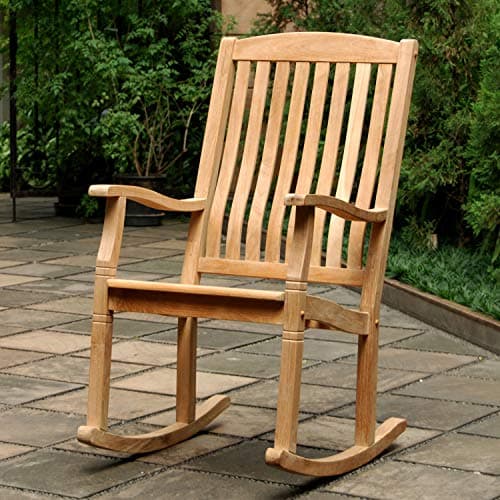 Cambridge Casual Arie Teak Wooden Outdoor Rocking ChairTeak heartwood carries its decay resistance in the timber, so neglect costs you color rather than the chair. | Best overall | 8.1 | $379.00 · View on Amazon #ad How we earn · Price as of November 2, 2026 |
| 2 | 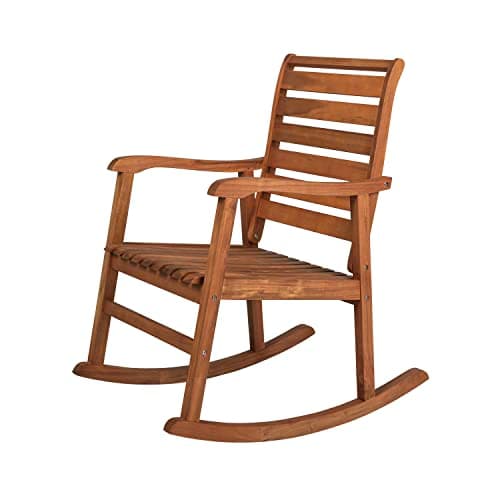 JONATHAN Y Carey Solid Acacia Wood Slat-Back Outdoor Rocking ChairSolid acacia with a slat back that drains, at a price where buying two is a normal decision. | Best value in acacia | 6.5 | $145.99 · View on Amazon #ad How we earn · Price as of November 2, 2026 |
| 3 | 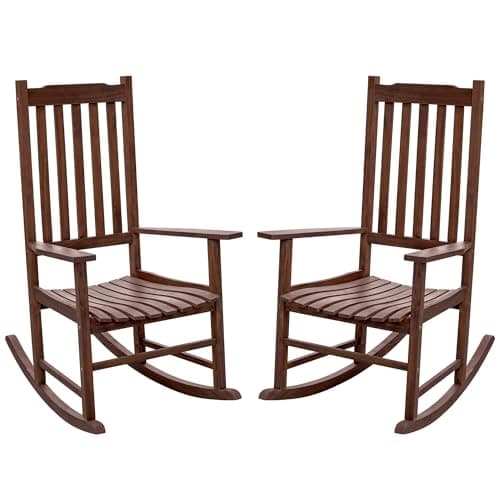 Flamaker Acacia Wood Outdoor Rocking Chairs Set of 2Two matching rockers for roughly one teak chair, which is how most porches actually get furnished. | Best pair | 6.1 | Check price on Amazon #ad How we earn · Live price at Amazon |
| 4 | 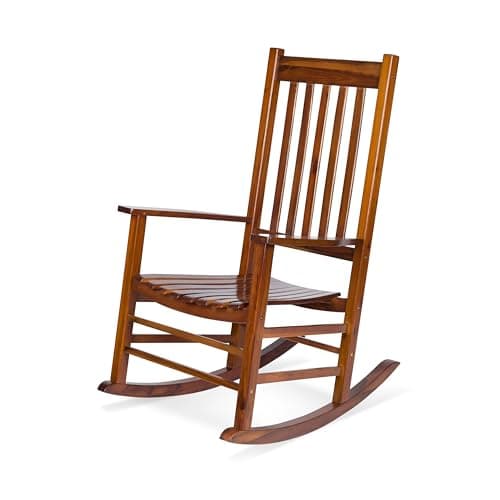 Shine Company Vermont Rocking Chair Classic OakThe tall-back traditional shape, in acacia - and Classic Oak is the finish name, not the species. | Classic porch profile | 6.0 | Check price on Amazon #ad How we earn · Live price at Amazon |
| 5 | No image POLYWOOD Jefferson Rocking ChairThe same motion in HDPE poly lumber, with no sealing schedule attached to it. | If you would rather not maintain one | 9.1 | Check price on Amazon #ad How we earn · Live price at Amazon |
Scores are our own, assessed from published specifications, warranty terms and owner-reported outcomes — not from laboratory testing. Prices are shown live on Amazon; we never print a figure we cannot verify.
The best wooden outdoor rocking chair is a teak one, and the Cambridge Casual Arie is the version of that argument available without going to a specialist. Teak heartwood carries its rot resistance inside the timber rather than in a finish, so a teak rocker left alone turns silver-gray and keeps working. Everything cheaper on this page is acacia, which is a genuinely good-looking chair attached to an annual sealing contract — and if that contract is the part you object to, the honest answer is a poly lumber rocker instead.
The short answer
For a rocker specifically, three things follow from choosing wood at all:
- Species sets the lifespan, not price and not brand. Teak heartwood runs 20 years and up outdoors. Acacia runs three to seven, and the top of that range only if you seal it every spring without missing one.
- Wood is the right material for the motion. A rocker is the one outdoor chair where mass is a feature. Wood damps the rock, stays put when you stand up, and does not skitter across a porch the way a light frame does.
- The runners are the part nobody inspects. They sit flat on a damp deck for months, which is the wettest contact any chair component has. More wooden rockers end there than anywhere else.
The species table
Two independent properties decide what a wood does outdoors, and they are routinely confused. Decay resistance is whether the timber's own extractives discourage the fungi that cause rot — the USDA Forest Products Laboratory classifies species by it. Hardness governs dents and wear and says nothing about rot. Teak demonstrates the gap: the Wood Database records teak at 1,070 lbf Janka and rates its rot resistance as very durable, while Acacia mangium comes in harder at 1,430 lbf with rot resistance recorded as no data available. The harder wood is the less durable one outdoors.
Wooden rocking chair species in full outdoor exposure
| Species | Decay resistance | Maintenance it requires | Realistic outdoor life |
|---|---|---|---|
| Teak heartwood | Very durable - resistance is in the timber | Optional. Clean when the gray bothers you | 20 years and up |
| Western red cedar | Durable, and light enough to move easily | Seal it or let it silver; either is viable | 10 to 15 years |
| White oak | Durable and very hard | An annual finish helps considerably | 10 to 15 years |
| Acacia | Moderate at best, and grade varies widely | Annual sealing is not optional | 3 to 7 years |
| Eucalyptus | Moderate, and prone to surface checking | Annual oiling plus winter storage | 4 to 8 years |
| Unnamed hardwood | Unknown, which is the finding | Treat it as acacia until proven otherwise | Assume the acacia bracket |
Teak sapwood is not teak heartwood and does not carry the same extractives. A cheap teak chair is usually cheap because of how much sapwood is in it, and no listing states the ratio.
What fails on a rocker specifically
A rocking chair is not just a chair with curved feet. It has three failure points that a static chair does not, and knowing them changes what you look at in a listing:
- The runners, where they meet the deck. Every other chair rests on four small feet; a rocker rests on two long strips of end-grain-adjacent timber lying flat against whatever moisture the deck holds. On an acacia rocker this is where rot starts, and it starts out of sight on the underside.
- The joints, under cyclic load. Rocking works every mortise, bolt and glue line thousands of times a season. A static chair gets loaded and unloaded; a rocker gets flexed. Glued butt joints fail here first, which is why through-bolted and mortise-and-tenon construction matters more on a rocker than on a dining chair.
- The fasteners. Plated steel hardware in wet wood corrodes, stains the surrounding timber black and eventually strips its hole — and on a rocker the hole is being worked every time somebody sits down. Stainless hardware is the cheapest meaningful upgrade available on a bolted wooden rocker, and it is a job you can do yourself with a wrench.
How the four wooden picks differ
The wooden rockers on this page, side by side
| Chair | Wood | Sold as | The reason to choose it |
|---|---|---|---|
| Cambridge Casual Arie | Solid teak | Single chair | The only one whose rot resistance survives being ignored |
| JONATHAN Y Carey | Solid acacia | Single chair | Slat back that drains, at the price where a pair is realistic |
| Flamaker Acacia Set of 2 | Solid acacia | Matching pair | A porch usually needs two, and this is the cheap route to two that match |
| Shine Company Vermont | Acacia, finished Classic Oak | Single chair | The traditional tall-back porch rocker shape the modern slat chairs do not give you |
Classic Oak on the Shine Company chair is the finish color. The listing states the wood as acacia. It is an easy thing to misread and worth knowing before you buy it as an oak chair.
The gap between the teak chair and the acacia chairs is roughly a factor of three on price and a factor of three to six on lifespan, which is unusually honest arithmetic for this category. Our teak versus acacia comparison works the trade through in full, and the acacia reference page covers what the wood does and does not do.
What a weather-resistant finish commits to
Most acacia outdoor furniture ships with a factory finish described as weather-resistant, and it is worth being clear about what that phrase does and does not promise. It is a coating. Coatings have a service life, they are consumed by UV and by water cycling, and when they reach the end of it the wood underneath has no protection at all.
So "weather-resistant finish" means the chair arrives protected, not that it stays protected. On acacia the practical reading is: one season before it needs attention, and an annual clean-and-reseal after that. Teak is the exception, because the resistance is in the timber and the finish is cosmetic — leave a teak rocker unfinished and it weathers to silver-gray without weakening.
Use a penetrating oil or a wood sealer when you do treat it, never a varnish. A film finish on a chair that flexes thousands of times a season cracks, water gets under the film, and the only honest fix is stripping the chair back. The full argument is on oil versus varnish.
Getting the fit right
Rockers are bought on looks and regretted on dimensions. Three numbers are worth checking against the listing before you order:
- Seat height at the front. A rocker sits lower than a dining chair and tips backward as you settle, so the effective height is lower still. If anyone in the household finds a low seat hard to leave, the seat-height arithmetic on our seniors page applies here too.
- Overall depth, front of runner to back of runner. This is the number that decides whether a rocker fits a porch, and it is always longer than the chair looks. Add four to six inches of travel behind it so the back does not knock the wall.
- Back height. A tall traditional back supports your head; a low slat back supports your shoulders. Neither is wrong, and they are completely different chairs to sit in for an hour.
The maintenance you are signing for
Per chair, per year, honestly stated:
- Teak: a wash once or twice a year. Optionally a clean-and-oil if you want to hold the honey color rather than let it silver. Zero obligation.
- Acacia: a spring clean, a light sand where the grain has raised, and a full reseal. Call it an afternoon per chair — which is why a pair is twice the work, not the same work.
- Any wooden rocker: check the runners underneath and the fasteners twice a season. Black staining around a bolt is the hardware telling you it is corroding.
- Winter: teak can stay out. Acacia lasts materially longer if it comes in or at least gets covered, per our winter storage guide.
The honest alternative
If you read the maintenance section and thought "no", that is a legitimate conclusion and it has a good answer. HDPE poly lumber gives you the same rocking motion, the same mass, slat construction that drains, and no maintenance contract at all — POLYWOOD publishes a 20-year residential warranty naming splintering, cracking, chipping, peeling and rot as covered, which is a claim no wooden chair in this category makes.
What you give up is grain. A poly rocker is a very good chair that does not look or feel like wood close up, and for some porches that is the whole point of the chair. The poly and composite options are ranked in our main rocking chairs roundup, and the material case is in POLYWOOD versus teak.
The picks in full
Each entry states what the product is, how it scores on our five criteria, what it gives up, and how the pick was made.
1. Best overall
Cambridge Casual Arie Teak Wooden Outdoor Rocking Chair
Cambridge Casual · Score 8.1/10
The buy-it-once wooden rocker: teak heartwood carries its own decay resistance, so neglect costs you color rather than the chair.
Key specifications
- Solid teak construction
- Rocking runners cut from the same timber as the frame
- Ships flat-packed; bolt-together assembly
- Unfinished or lightly finished depending on the variant
How it scores
- Fade resistance
- 8.0
- Rust and corrosion
- 8.0
- Wind and stability
- 8.5
- Build and hardware
- 8.5
- Warranty strength
- 6.0
What works
- Teak is the only wood on this list whose rot resistance is a property of the timber rather than of a finish
- Heavy enough that it does not walk across a porch when you get out of it
- Can be left to weather to silver-gray with no structural penalty
- Repairable: a damaged slat on a bolted teak chair is a replaceable part
The trade-offs
- Costs several times what an acacia rocker costs
- Teak sapwood content varies between suppliers and the listing does not state the grade
- Heavy to move, which is the flip side of it staying put
#ad How we earn · Price as of November 2, 2026
Selected on published specification, warranty terms and owner-reported outcomes; not personally tested.
2. Best value in acacia
JONATHAN Y Carey Solid Acacia Wood Slat-Back Outdoor Rocking Chair
JONATHAN Y · Score 6.5/10
Solid acacia at a price that makes a pair realistic, on the condition that you accept the annual sealing that acacia always comes with.
Key specifications
- Solid acacia hardwood
- Slat-back design
- Teak-toned factory finish
- Assembly required
How it scores
- Fade resistance
- 6.0
- Rust and corrosion
- 6.0
- Wind and stability
- 7.0
- Build and hardware
- 6.5
- Warranty strength
- 4.5
What works
- Real hardwood rather than a wood-look coating on a metal frame
- Slat back drains and dries instead of holding water in a panel
- Priced so that buying two for a porch is a normal decision
The trade-offs
- Acacia needs resealing every spring or it grays and the grain opens
- Hardware grade is not stated, and plated bolts stain wood as they corrode
- Lighter than teak, so it shifts more on a windy porch
#ad How we earn · Price as of November 2, 2026
Selected on published specification, warranty terms and owner-reported outcomes; not personally tested.
3. Best pair
Flamaker Acacia Wood Outdoor Rocking Chairs Set of 2
Flamaker · Score 6.1/10
Two matching acacia rockers for roughly what one teak rocker costs, which is the whole argument - and the whole compromise.
Key specifications
- Solid acacia wood, sold as a pair
- High back with widened armrests
- Assembly required on both chairs
- Factory finish
How it scores
- Fade resistance
- 5.5
- Rust and corrosion
- 5.5
- Wind and stability
- 6.5
- Build and hardware
- 6.0
- Warranty strength
- 4.0
What works
- A porch usually needs two rockers, and buying them as a pair is the cheap way to get there
- Wider armrests than the budget single rockers
- Matching pair out of the box, so no finish mismatch between chairs
The trade-offs
- Two chairs is two chairs to sand and reseal every spring
- Acacia grade is not stated, and acacia quality varies widely between suppliers
- Hardware grade is unstated, which on a chair that flexes under every rock is the part to watch
#ad How we earn · Live price at Amazon
Selected on published specification, warranty terms and owner-reported outcomes; not personally tested.
4. Classic porch profile
Shine Company Vermont Rocking Chair Classic Oak
Shine Company · Score 6.0/10
The classic high-back porch rocker shape, in acacia - and Classic Oak is the finish name, not the species.
Key specifications
- Acacia wood per the listing
- Classic Oak is the finish color, not the timber
- High-back porch rocker profile
- Weather-resistant factory finish
How it scores
- Fade resistance
- 5.5
- Rust and corrosion
- 6.0
- Wind and stability
- 6.5
- Build and hardware
- 6.0
- Warranty strength
- 4.0
What works
- The traditional tall-back porch rocker shape, which the modern slat rockers do not give you
- Cheapest genuine hardwood rocker here by a wide margin
- Light enough for one person to move on and off a porch seasonally
The trade-offs
- The color name invites people to buy it believing it is oak; it is acacia
- A factory weather-resistant finish is a coating, and coatings need renewing
- Light weight is a liability on an exposed deck
#ad How we earn · Live price at Amazon
Selected on published specification, warranty terms and owner-reported outcomes; not personally tested.
5. If you would rather not maintain one
POLYWOOD Jefferson Rocking Chair
POLYWOOD · Score 9.1/10
A porch rocker with no glued joints to loosen and no finish to strip — the two things that kill wooden rockers.
Key specifications
- 100% HDPE lumber with through-color
- Marine-grade stainless hardware
- 20-year residential warranty
- Weighted base geometry for a controlled rock
How it scores
- Fade resistance
- 9.5
- Rust and corrosion
- 9.5
- Wind and stability
- 8.0
- Build and hardware
- 9.0
- Warranty strength
- 9.5
What works
- Wooden rockers fail at the glued joints; there are none here
- Heavy enough that it does not walk across a porch
- Cleans with soap and water indefinitely
The trade-offs
- Expensive for a rocker
- Very heavy to reposition
#ad How we earn · Live price at Amazon
Selected on published specification, warranty terms and owner-reported outcomes; not personally tested.
Common questions
What is the best wood for an outdoor rocking chair?
How long do wooden outdoor rocking chairs last?
Do acacia rocking chairs need to be sealed every year?
Is a wooden rocking chair better than a poly one for a porch?
What does Classic Oak mean on an outdoor rocking chair?
Sources
- Teak (Tectona grandis) — The Wood Database. Checked 2026-10-15.
Janka hardness of 1,070 lbf for teak against its rot-resistance rating of 'very durable' — the pairing that shows hardness and decay resistance are independent properties.
- Acacia (genus overview) — The Wood Database. Checked 2026-10-15.
That acacia names a genus whose density is greatly variable, ranging from species lighter than black cherry to some of the heaviest and hardest woods in the world, and that the genus was recently split into five genera — the basis for this site's position that an acacia listing names no single material.
- Wood Handbook, Chapter 14: Biodeterioration of Wood — USDA Forest Products Laboratory. Checked 2026-09-23.
Heartwood decay-resistance categories, and the point that heartwood — not sapwood — carries a species' decay resistance.
- Effect of age on heartwood proportion, color, chemical composition, and biological resistance of teakwood — BioResources (NC State University). Checked 2026-09-23.
Peer-reviewed finding that teak heartwood is highly resistant to fungal attack while positions near pith and sapwood are only resistant — the basis for the Grade A / B / C distinction.
- POLYWOOD Limited Residential Warranty — POLYWOOD. Checked 2026-09-23.
The 20-year residential lumber warranty terms, including the splinter / crack / chip / peel / rot language and the sanding and painting exclusions.
Read next
More from Seating
Adirondacks, sectionals, loungers and rockers — our picks and the material logic behind each one.