Materials
Teak vs aluminum outdoor furniture
Both can last two decades. They ask completely different things of you to get there.
How this page is funded: Deck & Dusk earns a commission when you buy through the Amazon links below, at no extra cost to you. Commission never decides a ranking — our picks and our criteria are set before any link is added. Read the full disclosure.
Quick picks
One piece from each side of the comparison, plus the material that sidesteps both sets of trade-offs.
| # | Product | Best for | Score | Price |
|---|---|---|---|---|
| 1 | No image Cambridge Casual Teak Adirondack ChairHeartwood decay resistance with no coating that can fail - and it sands out. | The teak case | 7.8 | Check price on Amazon #ad How we earn · Live price at Amazon |
| 2 | 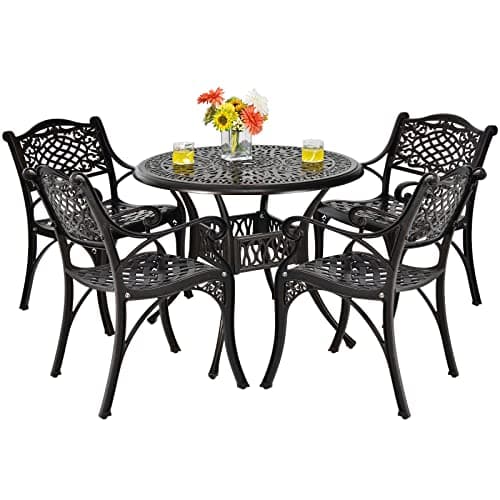 Tangkula 5-Piece Cast Aluminum Outdoor Dining SetCannot rust, needs no annual work, and gets hot in direct sun. | The aluminum case | 7.5 | $529.99 · View on Amazon #ad How we earn · Price as of October 11, 2026 |
| 3 | 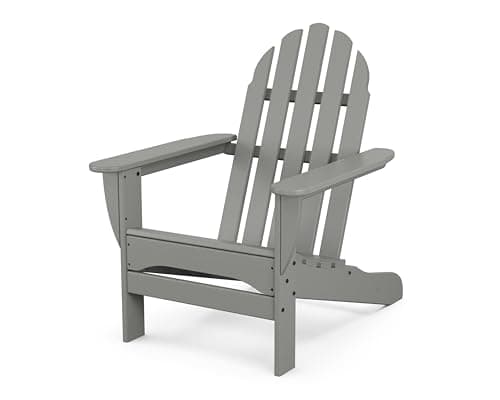 POLYWOOD Classic Adirondack ChairTwenty-year terms with no oiling and no coating to chip. | If neither trade-off appeals | 9.3 | $199.00 · View on Amazon #ad How we earn · Price as of October 11, 2026 |
Scores are our own, assessed from published specifications, warranty terms and owner-reported outcomes — not from laboratory testing. Prices are shown live on Amazon; we never print a figure we cannot verify.
Teak heartwood and cast aluminum are both twenty-year materials outdoors, so the choice is not about which lasts longer. Teak needs no coating and can be repaired, but it changes color and asks for cleaning. Aluminum needs nothing annual and cannot rust, but it gets hot in sun and its finish is a consumable you cannot renew properly.
The short answer
Buy teak if you want furniture you can repair and you are at peace with it going silver. Buy cast aluminum if you want to do nothing to it and you have shade. Those two sentences cover most of this decision, and everything below is the detail behind them.
The honest caveat on both sides is grade. "Teak" spans mature heartwood and plantation timber with substantial sapwood, and the USDA Forest Products Laboratory is clear that decay resistance lives in heartwood. "Aluminum" spans thick cast sections and thin tube, with a powder coat whose grade almost nobody publishes. The grade question matters more than the material question on both sides.
Side by side
Teak vs aluminum, attribute by attribute
| Attribute | Teak (heartwood) | Cast aluminum |
|---|---|---|
| Realistic service life | 20+ years, structurally | 15-20 years, set by the finish |
| Corrosion | Not applicable - it is wood | Cannot rust; oxide layer is protective |
| What fails first | Joint hardware, then trapped debris in end grain | Powder coat wear, then oxidation staining on bare patches |
| Annual maintenance | Clean joints; oil only if you want the honey color kept | None required; touch up coating chips |
| Appearance over time | Weathers to silver-gray unless oiled | Chalks and dulls slowly |
| Surface temperature in sun | Stays usable | Gets genuinely hot |
| Wind stability | Heavy; stays put | Cast is heavy; thin tube moves |
| Repairable? | Yes - sands and re-oils | Partly - touch-up paint, never a full refinish |
| Published standards to check | Grade and heartwood content (trade convention, not regulated) | AAMA 2604 / 2605 finish tiers (rarely stated on furniture) |
| Cushions needed? | Optional - slats are comfortable bare | Optional on contoured cast |
Both columns describe the good version of each material. Low-grade teak with heavy sapwood content and thin powder-coated tube aluminum are different products with much shorter lives.
The annual bill
This is where the two materials actually separate, and it is worth being concrete because the maintenance load is where most buyers end up unhappy.
Teak asks for an afternoon. Not for survival — untreated teak heartwood is structurally fine left alone — but for appearance. If you want honey rather than silver, that is a clean and an oil every year, and the chore scales with the number of pieces. Clearing debris out of joints is the part that genuinely extends life, and it takes minutes.
Aluminum asks for a tin of touch-up paint. There is no annual job. There is an occasional one: a coating chip on an aluminum frame is cosmetic rather than structural, but left alone it becomes an oxidation stain, and on a coastal site it starts pitting. Our salt-air page explains why that timeline shortens dramatically near the water.
Heat and wind
Two practical properties that comparison tables usually skip, and both favor wood.
Heat. Aluminum conducts, so a cast aluminum seat in direct afternoon sun is genuinely unpleasant to sit on, and the arms are worse. The fix is shade rather than a different finish color, which makes an umbrella part of the purchase if your patio faces the sun. Teak does not do this.
Wind. Mass is what keeps furniture on a deck. Teak is dense and heavy; cast aluminum is heavy; thin tube aluminum is not, and that is the version that goes over a railing. If you are comparing a teak chair against a lightweight aluminum one, you are not comparing like with like — see the metal comparison for how the constructions differ.
Repairability, which decides the long run
Over twenty years, repairability matters more than any spec on either product page, and this is the one place teak wins outright.
- Teak can be returned to new. A scorch, a scratch, a stain, a gray patina — all of it sands out, and a two-part chemical cleaner does most of the work with far less material removal than sanding. See our restoration guide.
- Aluminum cannot be refinished at home. A powder coat is applied electrostatically and cured in an oven; you can touch up a chip, and you cannot re-coat a frame in a garden. A dull, chalked frame stays dull.
- Both have replaceable hardware, which matters more than people expect. Bolted construction on either material means you can swap fasteners before they become the reason the furniture is scrapped.
How to choose
- Full-sun patio with no shade plan: teak. Aluminum will be too hot to use at the time of day you want to use it.
- You will not do any annual maintenance: aluminum, and accept that it will dull. Or skip both and read the poly lumber page.
- Coastal site: either, with reservations. Teak is unaffected by salt; aluminum resists it far better than steel. Both need their fasteners watched.
- You want it to look new in year fifteen: teak, because it is the only one of the two you can refinish.
- Exposed, windy deck: teak or cast aluminum. Not tube.
The picks in full
Each entry states what the product is, how it scores on our five criteria, what it gives up, and how the pick was made.
1. The teak case
Cambridge Casual Teak Adirondack Chair
Cambridge Casual · Score 7.8/10
Real teak at an accessible price, which in practice means plantation teak: genuinely weatherproof, with more sapwood than a marine-grade board.
Key specifications
- Plantation-grown teak
- Brass or stainless fasteners depending on model
- Ships partly assembled
- Will silver within roughly a year outdoors unless oiled
How it scores
- Fade resistance
- 7.0
- Rust and corrosion
- 8.5
- Wind and stability
- 8.5
- Build and hardware
- 8.0
- Warranty strength
- 6.0
What works
- Teak heartwood carries its own decay resistance — no coating to fail
- Repairable and sandable, unlike every plastic in this list
- Ages into a gray that many people prefer to the honey color
The trade-offs
- Needs cleaning and optional oiling if you want to keep the color
- Lower grades include sapwood, which is the weak link outdoors
- Heavier and pricier than HDPE for a similar service life
#ad How we earn · Live price at Amazon
Selected on published specification, warranty terms and owner-reported outcomes; not personally tested.
2. The aluminum case
Tangkula 5-Piece Cast Aluminum Outdoor Dining Set
Tangkula · Score 7.5/10
Cast aluminum is the quiet right answer for a small dining set: it cannot rust, and the weight problem solves itself.
Key specifications
- Cast aluminum frame and chairs
- Powder-coated finish
- Four chairs and a table
- No cushions required
How it scores
- Fade resistance
- 7.5
- Rust and corrosion
- 9.0
- Wind and stability
- 7.5
- Build and hardware
- 7.5
- Warranty strength
- 5.5
What works
- Aluminum does not rust — the single biggest failure mode in metal furniture is gone
- Cast sections are heavy enough to stay put without being immovable
- Powder coat is repairable with touch-up paint
The trade-offs
- The surface gets hot in direct sun
- Powder-coat grade is rarely stated, so coating life is the unknown
- Cast aluminum chips if something hard hits an edge
#ad How we earn · Price as of October 11, 2026
Selected on published specification, warranty terms and owner-reported outcomes; not personally tested.
3. If neither trade-off appeals
POLYWOOD Classic Adirondack Chair
POLYWOOD · Score 9.3/10
The reference HDPE Adirondack: color compounded through the lumber, a 20-year residential warranty, and nothing on it to rust or splinter.
Key specifications
- 100% HDPE lumber, color and UV inhibitors compounded through the material
- Marine-grade stainless hardware
- 20-year residential lumber warranty
- Arrives flat-packed; bolt-together assembly
How it scores
- Fade resistance
- 9.5
- Rust and corrosion
- 9.5
- Wind and stability
- 8.5
- Build and hardware
- 9.0
- Warranty strength
- 9.5
What works
- Fade behavior is a material property here, not a surface coat that can wear off
- Warranty language explicitly covers splintering, cracking, chipping, peeling and rot
- Heavy enough to stay put on a gusty evening
- Washes clean with soap and water — no sealing, oiling or refinishing, ever
The trade-offs
- Costs multiples of a big-box resin chair, and the value only shows up over years
- Heavy to move around a deck on your own
- Sanding it voids the warranty, so deep scratches stay
#ad How we earn · Price as of October 11, 2026
Selected on published specification, warranty terms and owner-reported outcomes; not personally tested.
Common questions
Which lasts longer, teak or aluminum patio furniture?
Does aluminum patio furniture get too hot to sit on?
Can you refinish aluminum patio furniture like teak?
Is teak or aluminum better for a coastal patio?
Sources
- Effect of age on heartwood proportion, color, chemical composition, and biological resistance of teakwood — BioResources (NC State University). Checked 2026-09-23.
Peer-reviewed finding that teak heartwood is highly resistant to fungal attack while positions near pith and sapwood are only resistant — the basis for the Grade A / B / C distinction.
- Wood Handbook, Chapter 14: Biodeterioration of Wood — USDA Forest Products Laboratory. Checked 2026-09-23.
Heartwood decay-resistance categories, and the point that heartwood — not sapwood — carries a species' decay resistance.
- Understanding AAMA 2604 vs. AAMA 2605 — AMICO Architectural Metals. Checked 2026-09-23.
The South Florida natural-weathering requirement behind each tier — 5 years for 2604, 10 years for 2605 — and the 50% vs 70% fluoropolymer resin difference.
- AAMA Paint Specifications — Linetec. Checked 2026-09-23.
The AAMA 2603 / 2604 / 2605 architectural finish tiers used as the yardstick for what a powder coat on aluminum is actually rated to do.
- 304 vs 316 Stainless Steel Screws — SFS USA. Checked 2026-09-23.
Why 316 fasteners resist chloride pitting and 304 do not: the 2-3% molybdenum addition that stabilizes the passive layer.
- Product Warranty — Cambridge Casual. Checked 2026-09-24.
The one-year manufacturer limited warranty on wood frames and cushions, and the exclusion of natural fading and changes in wood frames from that cover.
Read next
More from Materials
Five materials, five very different outcomes after five summers. Start here if you are choosing.