Durability
How long does metal patio furniture last?
Aluminum outlives the house. Steel outlives the warranty, and not much longer.
How this page is funded: Deck & Dusk earns a commission when you buy through the Amazon links below, at no extra cost to you. Commission never decides a ranking — our picks and our criteria are set before any link is added. Read the full disclosure.
Quick picks
One of each, so the difference is concrete: a cast aluminum set that cannot rust, and a steel bistro set where the coating is the entire warranty.
| # | Product | Best for | Score | Price |
|---|---|---|---|---|
| 1 | 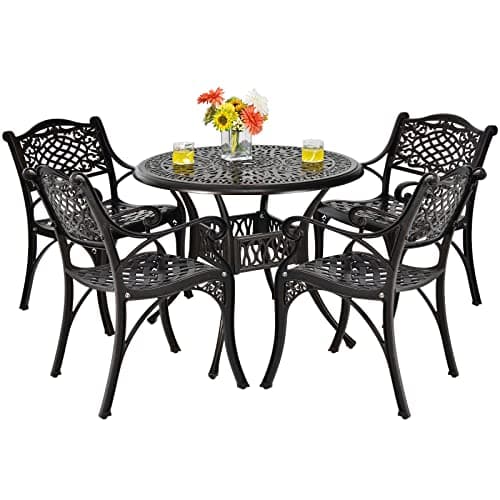 Tangkula 5-Piece Cast Aluminum Outdoor Dining SetCast aluminum has no iron in it, so the main failure mode does not exist. | The decades end | 7.5 | $529.99 · View on Amazon #ad How we earn · Price as of October 11, 2026 |
| 2 | 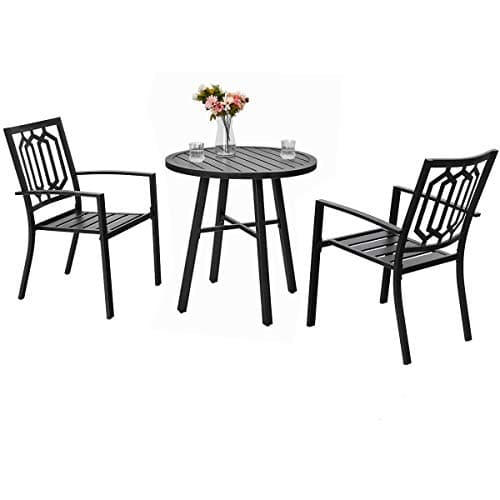 PHI VILLA 3-Piece Outdoor Bistro SetPowder-coated steel: every chip starts a clock you cannot stop. | The short end | 5.5 | $253.99 · View on Amazon #ad How we earn · Price as of October 11, 2026 |
| 3 | 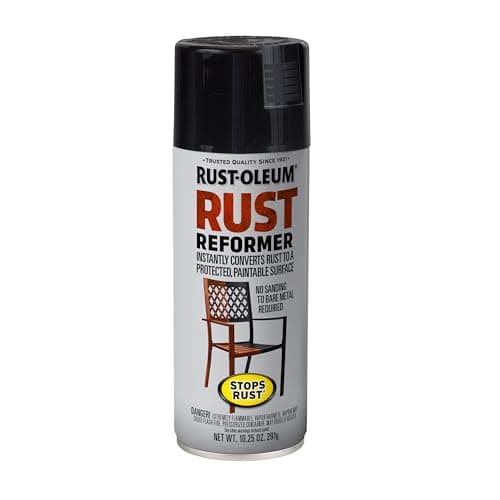 Rust-Oleum Stops Rust Rust ReformerConverts existing rust to a paintable surface - with a top coat over it. | Buying a steel frame more time | 6.6 | $9.49 · View on Amazon #ad How we earn · Price as of October 11, 2026 |
Scores are our own, assessed from published specifications, warranty terms and owner-reported outcomes — not from laboratory testing. Prices are shown live on Amazon; we never print a figure we cannot verify.
The short answer
"Metal patio furniture" covers two materials with lifespans an order of magnitude apart. Aluminum furniture, cast or extruded, routinely lasts fifteen to twenty years and often longer, because it has no iron in it and therefore cannot rust. Powder-coated steel furniture typically lasts two to five years outdoors before corrosion becomes structural, and less than that in a wet or coastal climate. Stainless steel lasts longest of all but appears almost exclusively as fasteners rather than frames. If the listing says only "metal frame," assume steel and assume the short figure.
Lifespan by metal
Outdoor lifespan by structural metal
| Metal | Typical outdoor life | What ends it | Coastal penalty |
|---|---|---|---|
| Cast aluminum | 15-20 years structurally | Finish appearance, or a cracked casting from impact | Minor - pitting at coating breaches only |
| Extruded aluminum | 15-20 years structurally | Bent tube or joint wear before any corrosion | Minor |
| Powder-coated steel | 2-5 years | Rust through from inside the tube and out of fastener holes | Severe - often halves it |
| Galvanized steel | Longer than painted steel, still finite | Zinc layer consumed, then ordinary rusting begins | Significant |
| Wrought iron (solid section) | Decades, with active maintenance | Neglect - it rusts freely and is kept alive by repainting | Significant |
| Stainless steel | Longest, but rarely a frame material | Chloride pitting on 304 near salt water | Low on 316, moderate on 304 |
These are editorial assessments built from material behavior, published coating specifications and warranty terms, not measurements from a test program. /how-we-test sets out the method.
Why the gap is so wide
Both metals corrode. The difference is what the corrosion product does once it forms.
Aluminum oxide is dense, bonds tightly to the metal and re-forms instantly when scratched. It seals the surface, so corrosion stops itself. Scratch an aluminum frame down to bare metal and it dulls to gray and then does nothing more.
Iron oxide does the opposite. It occupies more volume than the steel it came from, so it lifts and flakes, and every flake exposes fresh metal. The process accelerates rather than self-limiting. On tubular furniture it usually starts on the inside, where condensation collects and nothing ever dries, which is why a steel set can look sound right up until a leg folds. Our steel vs aluminum page is the full head-to-head, and best metal for outdoor furniture is the buying decision.
One genuine qualification: aluminum is softer. It dents where steel would resist, and a cast aluminum part that cracks from impact cannot usefully be repaired. Aluminum wins decisively on corrosion, not on every axis. The aluminum lifespan page goes deeper into the coating question specifically.
What fails first on each
The two metals fail in different places, which means you inspect them differently:
- On aluminum, the finish fails before the metal. Chalking, fade and loss of gloss. That is an appearance problem on furniture that is still structurally fine, and the AAMA 2604 and 2605 tiers — five versus ten years of South Florida weathering — are the industry yardstick for how long a finish should hold. Consumer furniture rarely states a tier, so an unstated coating is an unknown.
- On steel, the fastener holes fail first. Every hole is a coating breach the manufacturer created. Look for rust streaks running out of bolt holes, not at the middle of tubes.
- On both, mixed hardware is a hidden failure mode. A plated steel bolt in an aluminum frame sets up galvanic corrosion, and the stainless grade matters near salt water.
- On sling and wicker furniture, the frame is the metal. The fabric or weave usually outlives a steel frame and is outlived by an aluminum one.
Warranty wording is a decent proxy for all of this: brands that separate frame coverage from finish coverage, as the Yardbird warranty does, are telling you which part they expect to outlast the other.
Extending either one
Aluminum needs almost nothing; steel needs attention on a schedule. The useful habits:
- Inspect fastener holes twice a year on anything steel. This is the whole program. Rust found at a bolt hole is fixable; rust found at a failed joint is not.
- Touch up coating chips immediately on steel, at leisure on aluminum. The sequence — abrade, clean, convert, top coat — is on our rust guide.
- Keep water out of tube ends. Check that drainage holes and plastic feet are present and clear. A tube that fills and freezes splits.
- Replace plated fasteners with stainless. Cheap, and it removes the most common starting point for both rust and galvanic corrosion.
- Rinse coastal furniture with fresh water regularly. Salt that has been rinsed off is not attacking anything — see the coastal salt air page.
The picks in full
Each entry states what the product is, how it scores on our five criteria, what it gives up, and how the pick was made.
1. The decades end
Tangkula 5-Piece Cast Aluminum Outdoor Dining Set
Tangkula · Score 7.5/10
Cast aluminum is the quiet right answer for a small dining set: it cannot rust, and the weight problem solves itself.
Key specifications
- Cast aluminum frame and chairs
- Powder-coated finish
- Four chairs and a table
- No cushions required
How it scores
- Fade resistance
- 7.5
- Rust and corrosion
- 9.0
- Wind and stability
- 7.5
- Build and hardware
- 7.5
- Warranty strength
- 5.5
What works
- Aluminum does not rust — the single biggest failure mode in metal furniture is gone
- Cast sections are heavy enough to stay put without being immovable
- Powder coat is repairable with touch-up paint
The trade-offs
- The surface gets hot in direct sun
- Powder-coat grade is rarely stated, so coating life is the unknown
- Cast aluminum chips if something hard hits an edge
#ad How we earn · Price as of October 11, 2026
Selected on published specification, warranty terms and owner-reported outcomes; not personally tested.
2. The short end
PHI VILLA 3-Piece Outdoor Bistro Set
PHI VILLA · Score 5.5/10
Balcony-scale seating that does its job, made of the one material this site keeps warning about.
Key specifications
- Powder-coated steel frame
- Two chairs plus a small table
- Textilene or slat seat depending on model
- Compact footprint for balconies
How it scores
- Fade resistance
- 6.0
- Rust and corrosion
- 4.5
- Wind and stability
- 6.5
- Build and hardware
- 6.0
- Warranty strength
- 4.0
What works
- Fits where nothing else fits
- Inexpensive
- Heavy enough for a windy balcony
The trade-offs
- Steel: every chip in the powder coat becomes a rust bloom
- Small tables tip more easily than they look like they will
#ad How we earn · Price as of October 11, 2026
Selected on published specification, warranty terms and owner-reported outcomes; not personally tested.
3. Buying a steel frame more time
Rust-Oleum Stops Rust Rust Reformer
Rust-Oleum · Score 6.6/10
Converts existing rust into a paintable surface, which is the only honest fix once a powder coat has already failed.
Key specifications
- Converts rust to a flat black paintable surface
- Spray application over wire-brushed rust
- Top-coat with an enamel afterward
- For steel and iron, not aluminum
How it scores
- Fade resistance
- 6.0
- Rust and corrosion
- 8.0
- Wind and stability
- 6.0
- Build and hardware
- 7.0
- Warranty strength
- 4.5
What works
- Buys years on a steel frame that would otherwise be scrapped
- Cheap relative to replacing the furniture
The trade-offs
- It treats rust; it does not undo the metal loss already there
- Needs a top coat or it will not last
- Pointless on aluminum, which does not rust in the first place
#ad How we earn · Price as of October 11, 2026
Selected on published specification, warranty terms and owner-reported outcomes; not personally tested.
Common questions
How long does metal patio furniture last?
Does metal patio furniture rust?
Is aluminum or steel better for outdoor furniture?
How can you tell if patio furniture is aluminum or steel?
How do you make metal patio furniture last longer?
Sources
- AAMA Paint Specifications — Linetec. Checked 2026-09-23.
The AAMA 2603 / 2604 / 2605 architectural finish tiers used as the yardstick for what a powder coat on aluminum is actually rated to do.
- Understanding AAMA 2604 vs. AAMA 2605 — AMICO Architectural Metals. Checked 2026-09-23.
The South Florida natural-weathering requirement behind each tier — 5 years for 2604, 10 years for 2605 — and the 50% vs 70% fluoropolymer resin difference.
- 304 vs 316 Stainless Steel Screws — SFS USA. Checked 2026-09-23.
Why 316 fasteners resist chloride pitting and 304 do not: the 2-3% molybdenum addition that stabilizes the passive layer.
- Yardbird Outdoor Furniture Warranty — Yardbird. Checked 2026-09-24.
Published cover by component — 10 years on aluminum, teak and HDPE poly frames, 5 years on the aluminum finish, 3 years on the HDPE wicker weave and 1 year on cushions.
Read next
More from Durability & Lifespan
Lifespan by material, the three failure modes that end most patio sets, and how to read a warranty.