Shade
The best patio umbrella for a deck
A deck gives you no ground to anchor into and boards that mark. That changes the answer.
How this page is funded: Deck & Dusk earns a commission when you buy through the Amazon links below, at no extra cost to you. Commission never decides a ranking — our picks and our criteria are set before any link is added. Read the full disclosure.
Quick picks
Chosen for a wooden surface specifically: nothing here needs a ground anchor, and nothing here is cast iron sitting directly on your boards.
| # | Product | Best for | Score | Price |
|---|---|---|---|---|
| 1 | 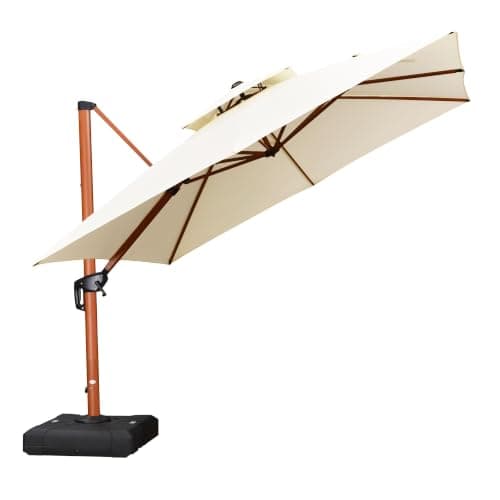 PURPLE LEAF 10ft Cantilever Patio UmbrellaOffset shade with no pole hole needed, so the furniture layout stays yours. | Best overall for a deck | 6.8 | $429.00 · View on Amazon #ad How we earn · Price as of October 11, 2026 |
| 2 | 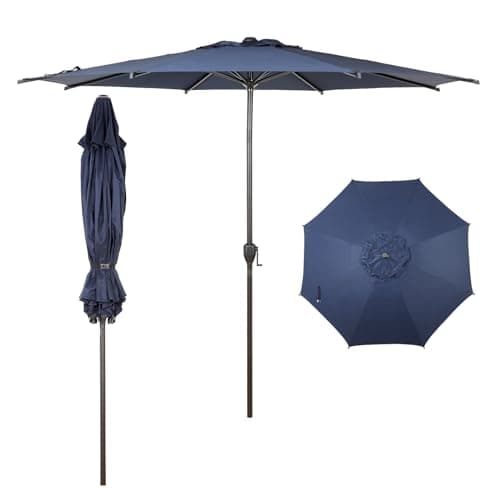 Abba Patio 9ft Market Umbrella with Push-Button TiltThrough-table is the sturdiest deck setup, because the table carries the load. | Decks with a dining table | 6.3 | $34.34 · View on Amazon #ad How we earn · Price as of October 11, 2026 |
| 3 | 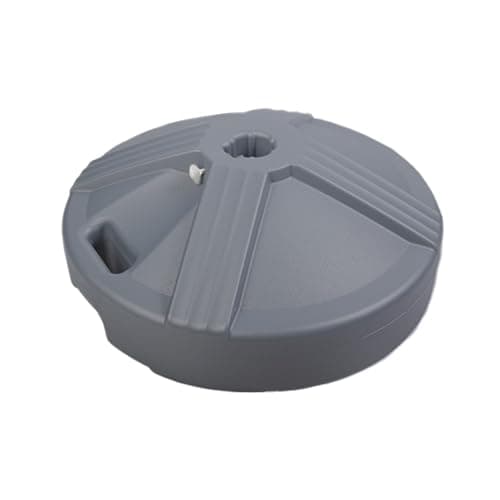 US Weight Durable Umbrella BaseA fillable resin shell instead of the cast iron that leaves rust marks on wood. | Weight without the stains | 7.4 | $22.87 · View on Amazon #ad How we earn · Price as of October 11, 2026 |
| 4 | 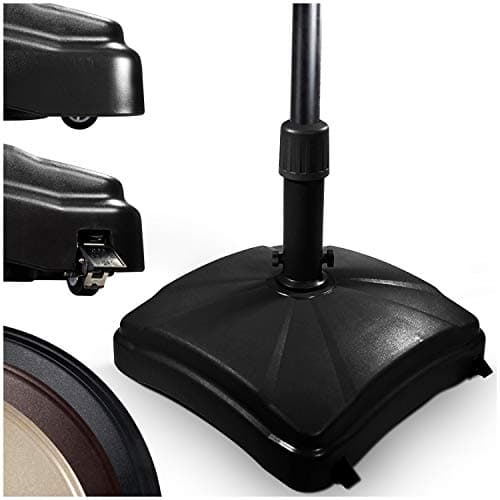 Shademobile Rolling Umbrella BaseWheels mean you reposition it instead of dragging weight across the boards. | Chasing the sun | 7.5 | $169.00 · View on Amazon #ad How we earn · Price as of October 11, 2026 |
Scores are our own, assessed from published specifications, warranty terms and owner-reported outcomes — not from laboratory testing. Prices are shown live on Amazon; we never print a figure we cannot verify.
Why a deck is different
On a deck the best patio umbrella is one that is held down by weight you can move, not by an anchor you sink — and for most decks that means either an offset cantilever on a cross base or a market umbrella passed through a dining table. The top pick here is the cantilever, because it shades a seating group without demanding a table with a hole in it. A deck removes the two things a patio gives you: solid ground to anchor into, and a surface that does not care what you stand on it. Everything below follows from those two absences.
Nothing to anchor into
On a patio you have options this page cannot use: a sleeve set into the slab, a ground screw, a spike. On a deck the realistic choices are:
- Freestanding weighted base. The default, and the one most people want. Everything depends on choosing enough weight and the right footprint.
- Through-table. The umbrella passes through a hole in the table and is held by a lighter base beneath it. Mechanically the best of these options, because the table resists the sideways load.
- Deck-mounted socket. A plate bolted through the decking into framing. Genuinely strong, but it is a permanent penetration through your deck surface and it must land on a joist, not on board alone. Worth it if you are certain where the umbrella lives forever; a poor trade if you are not.
- Railing mount. Convenient and limited — a railing is designed to resist people leaning on it, not a canopy levering on it all afternoon. Treat it as shade for a small balcony table, not for a seating group.
What a loaded base does to boards
A filled umbrella base is a heavy object with a small footprint, and a deck is a floor with gaps in it. Three things go wrong, and all three are avoidable:
Deck-surface problems and what prevents them
| Problem | Why it happens | What prevents it |
|---|---|---|
| Rust staining on the boards | Cast iron bases corrode where they meet standing water on a flat surface | A resin or fillable shell, or a pad under a metal base |
| Compression marks and crushed fibers | All the ballast arriving through two or three small feet | A wider footprint or a cross base spreading load to the corners |
| A foot dropping into a board gap | Small round feet are narrower than the drainage gap between boards | A base with a continuous bottom or a pad, aligned across the boards |
| Trapped damp under the base | Nothing dries beneath a flat weight sitting on wood | Lift and move it periodically, or use a rolling base you already move |
A rolling base solves the last two almost incidentally, because a base you can move is a base that gets moved.
This is the main reason the fillable resin base is a pick here rather than a heavier cast iron one. On concrete, cast iron is simply weight. On a wooden deck it is weight that corrodes and marks what it is standing on. Our bases roundup compares fill and geometry in full, and the coastal page makes the same argument where salt air is in play.
Through-table: the sturdiest option
If your deck has a dining table with a pole hole, use it. The table is doing real structural work: it holds the pole at mid height, which drastically shortens the lever arm the base has to fight. A modest base under a table-supported umbrella can be more stable than a very heavy base holding the same umbrella freestanding.
Two details decide whether it works. The pole diameter has to match the table hole — the reducer rings supplied with many umbrellas take up the difference, and a loose pole in an oversized hole will chatter and wear. And the base has to sit flat under the table, which on a deck means checking it is not straddling a board gap. Sizing the canopy to the table is covered on our sizing guide, and our dining-set-with-umbrella roundup covers choosing the table and umbrella together.
When to go cantilever instead
A cantilever is the right answer on a deck when there is no table hole to use, or when the area you want shaded is a sofa and chairs rather than a table. It buys you a clear floor and shade you can swing around as the sun drops.
The cost is ballast, and on a deck that cost is paid partly in point load. A cross base is close to mandatory: it spreads the resisting weight to four corners, which both generates more restoring moment and distributes the load across more of the deck structure than a single puck under the mast. Try to position it over or near a joist line rather than mid-span, and avoid a layout where the whole weight sits on one cantilevered corner of the deck.
Railings, roofs and edges
Three deck-specific checks that are easy to forget until the umbrella is open:
- Canopy versus railing. A canopy that overhangs the railing drips outside the deck, which is usually fine, and catches more wind, which is not. On a narrow deck a smaller canopy that stays inboard is often the better buy.
- Overhead clearance. If the deck sits under an eave, a pergola or a second-story overhang, measure the clearance before buying. Cantilevers need headroom to rotate, not just to open.
- Where the water goes. A canopy sheds a surprising volume of rain off its edges in one line. Point that line at the yard rather than at the door, the grill, or the one patch of decking that never dries out.
The deck checklist
- Does the table have a hole? If yes, through-table is the sturdiest and cheapest route. If no, plan on a cantilever and a cross base.
- Choose a base that will not mark the boards. Fillable resin, or a pad under anything made of iron.
- Check the footprint against your board gaps. Small round feet fall into them.
- Put the weight near framing, not mid-span, and not on an unsupported corner.
- Measure overhead clearance and the railing line before you buy the span.
The picks in full
Each entry states what the product is, how it scores on our five criteria, what it gives up, and how the pick was made.
1. Best overall for a deck
PURPLE LEAF 10ft Cantilever Patio Umbrella
PURPLE LEAF · Score 6.8/10
Cantilever shade without a pole through the table, on the condition you weight the base properly — which is not optional.
Key specifications
- 10ft offset canopy with 360-degree rotation
- Aluminum frame
- Crank lift with multi-position tilt
- Base weights sold separately on most listings
How it scores
- Fade resistance
- 7.0
- Rust and corrosion
- 8.0
- Wind and stability
- 5.5
- Build and hardware
- 7.0
- Warranty strength
- 5.5
What works
- Shades a seating group without a pole in the middle of it
- Rotates to follow the sun through an afternoon
- Aluminum frame will not rust
The trade-offs
- Cantilever geometry is inherently less wind-stable than a center pole
- The cross base needs heavy plates that are usually a separate purchase
- Much heavier to put away for winter
#ad How we earn · Price as of October 11, 2026
Selected on published specification, warranty terms and owner-reported outcomes; not personally tested.
2. Decks with a dining table
Abba Patio 9ft Market Umbrella with Push-Button Tilt
Abba Patio · Score 6.3/10
The default mid-price market umbrella: adequate fabric, adequate frame, no illusions about high wind.
Key specifications
- 9ft canopy, eight ribs
- Rust-resistant aluminum pole
- Push-button tilt
- Polyester canopy on standard variants
How it scores
- Fade resistance
- 6.0
- Rust and corrosion
- 7.5
- Wind and stability
- 6.0
- Build and hardware
- 6.5
- Warranty strength
- 5.0
What works
- Covers a standard six-seat table
- Simple mechanism with little to break
- Broad color range
The trade-offs
- Polyester canopy fades faster than solution-dyed acrylic
- Single-tier canopy has no vent to relieve wind load
#ad How we earn · Price as of October 11, 2026
Selected on published specification, warranty terms and owner-reported outcomes; not personally tested.
3. Weight without the stains
US Weight Durable Umbrella Base
US Weight · Score 7.4/10
Fillable rather than cast, so it ships light and weighs what it needs to once you fill it — and it cannot rust.
Key specifications
- Fillable resin base
- Accepts sand or water fill
- Fits standard market umbrella poles
- No steel structure to corrode
How it scores
- Fade resistance
- 7.0
- Rust and corrosion
- 9.5
- Wind and stability
- 7.5
- Build and hardware
- 7.0
- Warranty strength
- 5.0
What works
- Cheap to ship empty, heavy once filled with sand
- Nothing on it rusts, unlike a cast-iron base
- Sand fill weighs considerably more than the same volume of water
The trade-offs
- Water fill is much lighter than sand — most disappointment traces to this
- Resin looks less substantial than cast metal
#ad How we earn · Price as of October 11, 2026
Selected on published specification, warranty terms and owner-reported outcomes; not personally tested.
4. Chasing the sun
Shademobile Rolling Umbrella Base
Shademobile · Score 7.5/10
Solves the actual problem with heavy bases: a base heavy enough to work is too heavy to move, unless it has wheels.
Key specifications
- Fillable base with integrated wheels
- Sand or paver fill
- Tilt-and-roll handle
- Fits standard market umbrella poles
How it scores
- Fade resistance
- 7.0
- Rust and corrosion
- 8.0
- Wind and stability
- 8.0
- Build and hardware
- 7.5
- Warranty strength
- 5.0
What works
- You can load it properly and still move it, which means you will move it
- Heavier fill capacity than most free-standing bases
The trade-offs
- Costs more than a plain fillable base
- Wheels add height under the pole
#ad How we earn · Price as of October 11, 2026
Selected on published specification, warranty terms and owner-reported outcomes; not personally tested.
Common questions
What kind of patio umbrella is best for a wooden deck?
Will an umbrella base damage my deck?
Can you mount a patio umbrella to a deck?
Is a railing-mounted umbrella strong enough?
Do decks get more wind than patios?
Sources
- Beaufort Wind Chart — Estimating Wind Speeds — National Weather Service (NOAA). Checked 2026-09-23.
Wind-speed bands and their observable effects, used instead of manufacturer wind claims we cannot verify.
- About Us — US Weight. Checked 2026-10-01.
The manufacturer's statement that its management team and its manufacturing facility are both located in Olney, Illinois.
- Customer Support — Limited Warranty — Treasure Garden. Checked 2026-09-24.
Frame warranty lengths by umbrella style (3 years FLEX, 2 years auto-tilt and collar-tilt, 1 year push-button and accessories) and fabric fade cover of 5 years on Sunbrella, Outdura and Tempotest against 4 years on O'bravia.
Read next
More from Shade
Market and cantilever umbrellas, the fabric that holds color, and the base weight that keeps it standing.