Shade
Cantilever vs market umbrella
You are not buying more shade. You are buying shade in a place a pole cannot go, and paying for it in wind tolerance.
How this page is funded: Deck & Dusk earns a commission when you buy through the Amazon links below, at no extra cost to you. Commission never decides a ranking — our picks and our criteria are set before any link is added. Read the full disclosure.
Quick picks
One of each, plus the ballast each one needs - because the base is where the real price difference between these two designs shows up.
| # | Product | Best for | Score | Price |
|---|---|---|---|---|
| 1 | 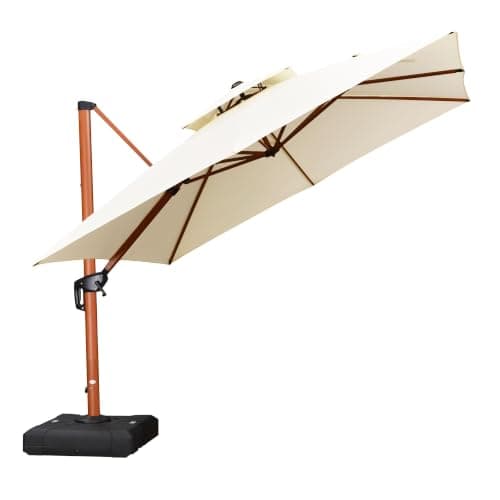 PURPLE LEAF 10ft Cantilever Patio UmbrellaRotates and tilts to follow an afternoon, provided the cross base gets properly loaded. | Best cantilever | 6.8 | $429.00 · View on Amazon #ad How we earn · Price as of October 16, 2026 |
| 2 | 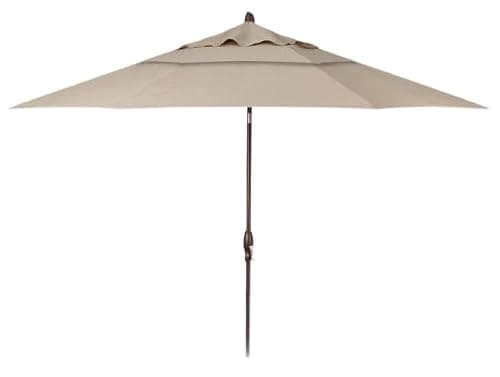 Treasure Garden Deluxe Auto-Tilt Market UmbrellaReplaceable canopy and ribs, and a tilt mechanism that still works after a few seasons. | Best market umbrella | 8.6 | $499.00 · View on Amazon #ad How we earn · Price as of October 16, 2026 |
| 3 | 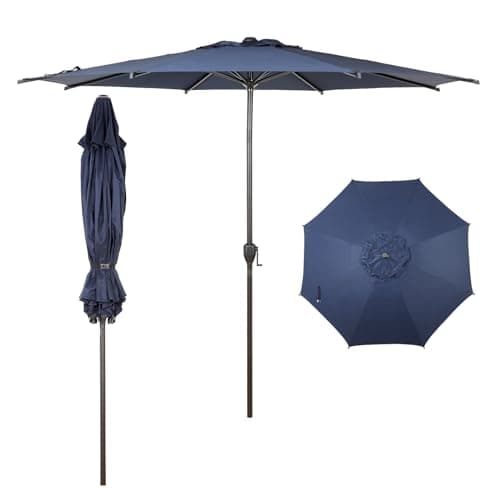 Abba Patio 9ft Market Umbrella with Push-Button TiltThe default nine-foot table umbrella: adequate frame, adequate fabric, honest price. | Mid-price market | 6.3 | $28.49 · View on Amazon #ad How we earn · Price as of October 16, 2026 |
| 4 | No image Abba Patio Steel Cross Base for Cantilever UmbrellasThe ballast an offset umbrella genuinely needs, and nearly always a separate purchase. | The cantilever's hidden cost | 6.7 | Check price on Amazon #ad How we earn · Live price at Amazon |
Scores are our own, assessed from published specifications, warranty terms and owner-reported outcomes — not from laboratory testing. Prices are shown live on Amazon; we never print a figure we cannot verify.
A cantilever umbrella is worth the upgrade over a market umbrella in exactly one situation: you need shade over something that has no hole in it — a sofa group, a sun lounger, a hot tub, a dining table you do not want a pole through. It is not worth it for more shade, better shade or better durability. On those counts a good market umbrella wins, costs less all in, and survives more wind.
The short answer
The two designs do not differ in canopy technology at all. The same fabrics, the same rib materials, the same vent choices appear on both. What differs is where the mast stands, and every consequence follows from that one geometric decision:
- A market umbrella puts the pole under the center of the canopy. Load goes straight down the mast into the base. The table braces the pole at a second height. It is a structurally efficient arrangement, which is why it is cheap and stable.
- A cantilever puts the mast to one side and holds the canopy out on an arm. Load arrives at the base as a bending moment rather than a compression, so the base has to resist tipping instead of simply supporting weight. That is a far more demanding job.
Everything people like about cantilevers (open space under the canopy, rotation around a seating group) and everything they complain about (ballast, wind, bulk, price) is this one difference showing up in different places.
What actually differs
Three practical differences are worth being precise about, because the marketing blurs all three.
Coverage is not larger, it is relocatable. A 10ft cantilever and a 10ft market umbrella cast nearly the same shadow. The cantilever can put that shadow where there is no pole position available, and can swing it through an afternoon without moving the base. That is genuinely useful and it is not extra area.
Tilt works differently. A market umbrella tilts the canopy about the top of the pole, which moves the shade a little and exposes one side of the canopy to wind. A cantilever rotates the whole arm, which moves shade a lot. For chasing the sun across a lounge group, rotation is the better mechanism by some distance.
Winter handling is a different job. A market umbrella comes out of its base and goes in a shed. A cantilever is a heavy articulated frame bolted to a loaded cross base, and taking it down is a two-person afternoon. Many owners simply do not, and leaving one up through winter is the most common way they get destroyed.
Side by side
Cantilever and market umbrellas on the things that decide the purchase
| Market umbrella | Cantilever / offset | |
|---|---|---|
| Where the shade can go | Only where a pole can stand, usually a table | Anywhere within reach of the arm - the real advantage |
| Shade per dollar | Clearly better | Worse, and not close |
| Wind stability | Good. Load runs straight down a braced pole | Poorer by design. The base resists a tipping moment |
| Base required | 50 to 125 lbs filled, often bought once | Cross base plus 200 lbs of plates or slabs |
| Base usually included? | Sometimes, usually too light | Frame sometimes; the weights almost never |
| Mechanism complexity | Crank and tilt. Little to fail | Crank, tilt, rotation and a hinged arm |
| Seasonal takedown | One person, five minutes | Two people, and often skipped as a result |
| Replaceable canopy and ribs | Common on better brands | Less common, and model-specific when offered |
| Best use | Dining tables, decks, anywhere with a pole position | Sofa groups, loungers, hot tubs, pole-free dining |
Both designs use the same canopy fabrics and rib materials, so fabric and fade performance is not a point of difference between them - it is a point of difference between price tiers within each.
The wind problem
This is the part that decides the purchase on an exposed site. A cantilever's canopy applies force at the end of a lever arm, so the same gust that a market umbrella passes down its pole as compression arrives at a cantilever base as a tipping moment measured in foot-pounds. Resisting it needs weight placed far out from the mast, which is why cross bases are wide and why they need plates rather than a tidy single casting.
The practical consequence: a properly loaded cantilever is fine in ordinary breezes and is still the first thing on the patio to go over in a squall. Neither design is a wind product — the honest reference is the NOAA Beaufort wind chart rather than any manufacturer wind rating, and the rule for both designs is that an open canopy in fresh wind is a sail. Vents and fiberglass ribs help, and they help on both; the best patio umbrella for wind is a market-umbrella page for exactly this reason.
The real cost difference
Compare the systems, not the umbrellas. A market umbrella needs a fillable base you load with sand once. A cantilever needs a cross base plus the plates or slabs to load it, which are usually excluded, and the quantity is substantial. That gap is frequently as large as the difference between the two umbrellas themselves — the reason our umbrella-and-base pairings page treats the base as part of the purchase rather than an accessory.
Then add the hidden running cost: lower wind tolerance and a takedown job people skip produce shorter service life. A cantilever that spends three winters standing up is not a better-value umbrella than a market umbrella that spends three winters in a shed.
Which one to buy
- Buy a market umbrella if the shade is going over a table with a hole in it, if the site is exposed, if you want replaceable parts, or if nobody is going to carry a cross base around in October. This is most people.
- Buy a cantilever if the thing needing shade cannot take a pole — a sectional, a lounger pair, a hot tub — or if you specifically want to swing the shade through an afternoon without shifting furniture. Then budget the ballast up front and close it whenever you leave.
- Buy neither if what you actually want is permanent shade over a fixed area. At that point a structure is the better product and an umbrella is a compromise you will keep re-buying.
If a cantilever is the answer, the models worth considering and the ones to avoid are in our cantilever roundup.
The picks in full
Each entry states what the product is, how it scores on our five criteria, what it gives up, and how the pick was made.
1. Best cantilever
PURPLE LEAF 10ft Cantilever Patio Umbrella
PURPLE LEAF · Score 6.8/10
Cantilever shade without a pole through the table, on the condition you weight the base properly — which is not optional.
Key specifications
- 10ft offset canopy with 360-degree rotation
- Aluminum frame
- Crank lift with multi-position tilt
- Base weights sold separately on most listings
How it scores
- Fade resistance
- 7.0
- Rust and corrosion
- 8.0
- Wind and stability
- 5.5
- Build and hardware
- 7.0
- Warranty strength
- 5.5
What works
- Shades a seating group without a pole in the middle of it
- Rotates to follow the sun through an afternoon
- Aluminum frame will not rust
The trade-offs
- Cantilever geometry is inherently less wind-stable than a center pole
- The cross base needs heavy plates that are usually a separate purchase
- Much heavier to put away for winter
#ad How we earn · Price as of October 16, 2026
Selected on published specification, warranty terms and owner-reported outcomes; not personally tested.
2. Best market umbrella
Treasure Garden Deluxe Auto-Tilt Market Umbrella
Treasure Garden · Score 8.6/10
The market umbrella people replace their third cheap umbrella with, usually after the third cheap umbrella.
Key specifications
- Aluminum pole with auto-tilt crank
- Sunbrella and other performance canopy fabrics offered
- Replaceable canopy and ribs
- Fabric warranty follows the fabric maker's terms
How it scores
- Fade resistance
- 9.0
- Rust and corrosion
- 8.5
- Wind and stability
- 7.0
- Build and hardware
- 9.0
- Warranty strength
- 8.5
What works
- Parts are replaceable, so a broken rib is not a landfill event
- Solution-dyed acrylic canopies are the only ones that hold color for years
- Auto-tilt actually works under load
The trade-offs
- Costs more than most people expect to spend on an umbrella
- Still must be closed in wind — no umbrella is a wind product
#ad How we earn · Price as of October 16, 2026
Selected on published specification, warranty terms and owner-reported outcomes; not personally tested.
3. Mid-price market
Abba Patio 9ft Market Umbrella with Push-Button Tilt
Abba Patio · Score 6.3/10
The default mid-price market umbrella: adequate fabric, adequate frame, no illusions about high wind.
Key specifications
- 9ft canopy, eight ribs
- Rust-resistant aluminum pole
- Push-button tilt
- Polyester canopy on standard variants
How it scores
- Fade resistance
- 6.0
- Rust and corrosion
- 7.5
- Wind and stability
- 6.0
- Build and hardware
- 6.5
- Warranty strength
- 5.0
What works
- Covers a standard six-seat table
- Simple mechanism with little to break
- Broad color range
The trade-offs
- Polyester canopy fades faster than solution-dyed acrylic
- Single-tier canopy has no vent to relieve wind load
#ad How we earn · Price as of October 16, 2026
Selected on published specification, warranty terms and owner-reported outcomes; not personally tested.
4. The cantilever's hidden cost
Abba Patio Steel Cross Base for Cantilever Umbrellas
Abba Patio · Score 6.7/10
The ballast a cantilever umbrella actually needs, in the material a cantilever base is unfortunately always made of.
Key specifications
- Four-arm cross base for offset umbrellas
- Accepts weight plates or patio slabs
- Powder-coated steel
- Sized for 10ft-plus cantilever frames
How it scores
- Fade resistance
- 6.0
- Rust and corrosion
- 5.0
- Wind and stability
- 9.0
- Build and hardware
- 7.0
- Warranty strength
- 4.5
What works
- Cross geometry resists the tipping moment a cantilever creates
- Takes standard patio slabs, which are cheaper than proprietary plates
The trade-offs
- Steel under standing water rusts at the contact points — keep it off wet ground
- Heavy and awkward to reposition once loaded
#ad How we earn · Live price at Amazon
Selected on published specification, warranty terms and owner-reported outcomes; not personally tested.
Common questions
Is a cantilever umbrella worth the extra money over a market umbrella?
Do cantilever umbrellas blow over more easily?
Does a cantilever umbrella give more shade than a market umbrella?
What base does a cantilever umbrella need?
Sources
- Customer Support — Limited Warranty — Treasure Garden. Checked 2026-09-24.
Frame warranty lengths by umbrella style (3 years FLEX, 2 years auto-tilt and collar-tilt, 1 year push-button and accessories) and fabric fade cover of 5 years on Sunbrella, Outdura and Tempotest against 4 years on O'bravia.
- Beaufort Wind Chart — Estimating Wind Speeds — National Weather Service (NOAA). Checked 2026-09-23.
Wind-speed bands and their observable effects, used instead of manufacturer wind claims we cannot verify.
- Sunbrella Warranty — Sunbrella (Glen Raven). Checked 2026-09-23.
Published warranty lengths: 5 years on upholstery and sling fabrics, 10 years on shade and marine fabrics, 3.5 years on recycled lines.
Read next
More from Shade
Market and cantilever umbrellas, the fabric that holds color, and the base weight that keeps it standing.