Shade
The best material for a patio umbrella
An umbrella is three materials doing three different jobs. Only one of them is the fabric.
How this page is funded: Deck & Dusk earns a commission when you buy through the Amazon links below, at no extra cost to you. Commission never decides a ranking — our picks and our criteria are set before any link is added. Read the full disclosure.
Quick picks
Three umbrellas that illustrate the three decisions - one that gets all three right, one that prioritizes ribs, one that prioritizes reach.
| # | Product | Best for | Score | Price |
|---|---|---|---|---|
| 1 | 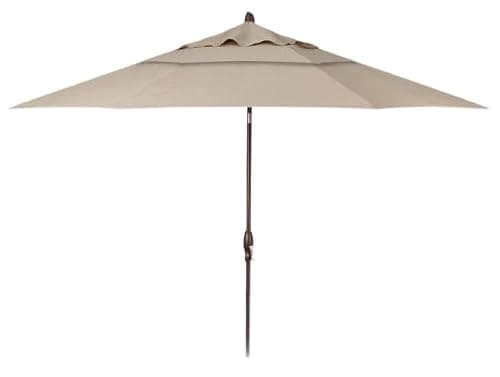 Treasure Garden Deluxe Auto-Tilt Market UmbrellaSolution-dyed acrylic canopy options, aluminum pole, and a canopy and ribs you can replace. | All three decisions right | 8.6 | $499.00 · View on Amazon #ad How we earn · Price as of October 16, 2026 |
| 2 | 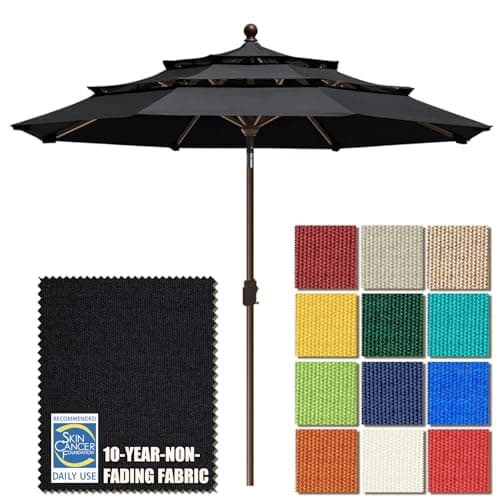 EliteShade USA 3-Tier Market Patio UmbrellaFiberglass-reinforced ribs on the wind-rated variants, which is where umbrellas actually break. | Ribs and vents first | 7.8 | $188.91 · View on Amazon #ad How we earn · Price as of October 16, 2026 |
| 3 | 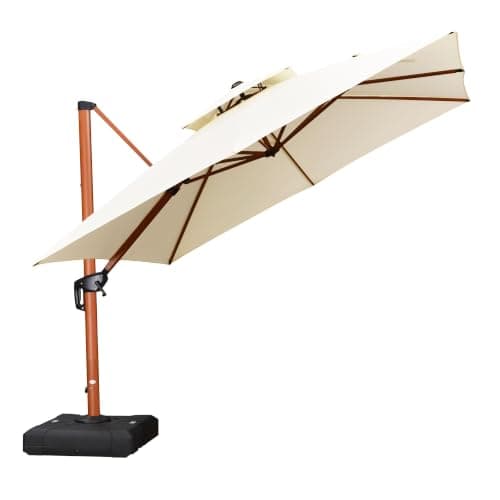 PURPLE LEAF 10ft Cantilever Patio UmbrellaAn aluminum cantilever frame - the material that matters most on a design this exposed. | Aluminum frame, offset reach | 6.8 | $429.00 · View on Amazon #ad How we earn · Price as of October 16, 2026 |
Scores are our own, assessed from published specifications, warranty terms and owner-reported outcomes — not from laboratory testing. Prices are shown live on Amazon; we never print a figure we cannot verify.
The best material for a patio umbrella is three answers, not one: a solution-dyed acrylic canopy, fiberglass ribs, and an aluminum pole. Those three choices decide fade life, wind survival and rust respectively, and they are independent — plenty of umbrellas get one right and the other two wrong. If you can only upgrade one, upgrade the ribs, because that is the part that actually fails.
The short answer
"What material is this umbrella" is really three questions:
- The canopy decides how long it looks acceptable. Failure mode: fade and fabric breakdown.
- The ribs decide whether it survives weather. Failure mode: a creased or snapped rib, usually in one gust.
- The pole decides whether it corrodes and how it handles load. Failure mode: rust at the base, or a bent two-piece joint.
Listings tend to lead with the fabric because fabric brands have names. The ribs are what get the umbrella to its third summer.
Canopy fabric
The distinction that matters is where the color lives. Solution-dyed fabric has the pigment added to the liquid polymer before the fiber is extruded, so color runs through the strand; piece-dyed and printed fabric has color applied to the outside of a finished fiber. UV attacks the outside first, which is why the two behave nothing alike in a second season.
- Solution-dyed acrylic is the right answer, and the fade warranties reflect it — Sunbrella publishes 10 years on its shade and marine fabrics. Treasure Garden's own terms cover fabric fade for five years on Sunbrella, Outdura and Tempotest.
- Solution-dyed olefin (polypropylene) is the value option: genuinely solution-dyed, lighter, slightly less UV-tolerant than acrylic, and considerably cheaper. A real choice rather than a compromise.
- Polyester is what most inexpensive umbrellas use. It is usually printed or piece-dyed, and in a high-UV climate it visibly goes inside two seasons. Fine on a shaded balcony, a consumable everywhere else.
- Vinyl-coated fabrics block light well and go stiff and crack with cold cycling. Commercial contexts only.
Weave density matters alongside fiber, and for the same reason it does in clothing: the Skin Cancer Foundation notes that densely woven cloth is more protective than sheer or loosely woven cloth, and that darker colors absorb UV rather than letting it through. A tight dark canopy shades better than a loose pale one, which is the trade-off umbrella color works through.
Rib material
This is the under-discussed decision and the one that decides whether you own the umbrella in three years.
- Fiberglass. Bends a long way and returns. In a gust a fiberglass rib deflects, dumps the load and recovers — which is exactly what you want from a structural member attached to a sail.
- Aluminum. Light, rust-free, and it creases. Past its yield point an aluminum rib takes a permanent kink, and a kinked rib never tensions the canopy properly again. This is the single most common way a mid-price umbrella dies.
- Steel. Strong, heavy, and it rusts from the inside where the canopy keeps it damp. Common on the cheapest umbrellas and the main reason they stain their own canopies.
- Wood. Handsome, heavy, splinters at the stress points, and asks for maintenance an umbrella rarely gets.
Pole material
Simpler. Aluminum is the default and the right one — it cannot rust, it is light enough to lift into a table ring, and a thick-walled aluminum pole is plenty strong for the loads a canopy generates. Steel poles are heavier and rust at the base where they stand in a wet base socket, which is also the least visible place on the umbrella. Hardwood poles look better than anything else and want oiling and dry winter storage.
Two details matter more than the metal: wall thickness, and whether the pole is one piece or two. A two-piece pole is easier to store and introduces a joint at the point of maximum bending. For an umbrella living outside all season, single-piece is worth the storage inconvenience.
All three, compared
Patio umbrella materials by component
| Component | Best choice | Acceptable | Avoid |
|---|---|---|---|
| Canopy fabric | Solution-dyed acrylic - color in the fiber | Solution-dyed olefin; genuinely good value | Printed polyester in a high-UV climate |
| Ribs | Fiberglass - bends and recovers | Thick-wall aluminum on a vented canopy | Steel, which rusts and stains the canopy |
| Pole | Thick-wall aluminum, single piece | Hardwood, if you will maintain it | Steel, and any thin two-piece pole |
| Hub and runner | Glass-reinforced nylon | Cast aluminum | Unreinforced plastic in cold climates |
| Base | Fillable resin, sand-filled | Cast aluminum | Cast iron, which rusts and stains decking |
Hub and runner parts are almost never specified in a listing. Their condition after two winters is the clearest tell of whether the umbrella was built to a specification or to a price.
Where to spend first
If the budget only stretches to one upgrade, the order is: ribs, then fabric, then pole, then base — with one correction. The base is not an upgrade, it is a requirement, and an excellent umbrella in an under-filled base is a worse purchase than a mediocre umbrella in a proper one. Get the base right, then spend on ribs.
The other spend worth making is on replaceability. An umbrella whose canopy and ribs are sold as parts is a frame you keep and a canopy you renew; one whose parts are unavailable is a single-use object with a good warranty. That is most of the argument for the premium brands, and it is covered in commercial-grade umbrellas. The fabric question on its own gets a longer treatment in our umbrella fabric guide.
The picks in full
Each entry states what the product is, how it scores on our five criteria, what it gives up, and how the pick was made.
1. All three decisions right
Treasure Garden Deluxe Auto-Tilt Market Umbrella
Treasure Garden · Score 8.6/10
The market umbrella people replace their third cheap umbrella with, usually after the third cheap umbrella.
Key specifications
- Aluminum pole with auto-tilt crank
- Sunbrella and other performance canopy fabrics offered
- Replaceable canopy and ribs
- Fabric warranty follows the fabric maker's terms
How it scores
- Fade resistance
- 9.0
- Rust and corrosion
- 8.5
- Wind and stability
- 7.0
- Build and hardware
- 9.0
- Warranty strength
- 8.5
What works
- Parts are replaceable, so a broken rib is not a landfill event
- Solution-dyed acrylic canopies are the only ones that hold color for years
- Auto-tilt actually works under load
The trade-offs
- Costs more than most people expect to spend on an umbrella
- Still must be closed in wind — no umbrella is a wind product
#ad How we earn · Price as of October 16, 2026
Selected on published specification, warranty terms and owner-reported outcomes; not personally tested.
2. Ribs and vents first
EliteShade USA 3-Tier Market Patio Umbrella
EliteShade · Score 7.8/10
Vents are the single feature that matters most in wind, and this is the widely available umbrella that has three of them.
Key specifications
- Three-tier vented canopy
- Fiberglass-reinforced ribs on the wind-rated variants
- Aluminum pole
- Crank lift with tilt
How it scores
- Fade resistance
- 7.5
- Rust and corrosion
- 8.0
- Wind and stability
- 8.5
- Build and hardware
- 7.5
- Warranty strength
- 6.0
What works
- Multiple vents let gusts pass through instead of lifting the canopy
- Fiberglass ribs bend and recover where aluminum ribs crease permanently
- Priced well below the premium brands
The trade-offs
- The canopy is not solution-dyed acrylic on every variant — check the listing
- Vented canopies pass a little more light than a flat canopy
#ad How we earn · Price as of October 16, 2026
Selected on published specification, warranty terms and owner-reported outcomes; not personally tested.
3. Aluminum frame, offset reach
PURPLE LEAF 10ft Cantilever Patio Umbrella
PURPLE LEAF · Score 6.8/10
Cantilever shade without a pole through the table, on the condition you weight the base properly — which is not optional.
Key specifications
- 10ft offset canopy with 360-degree rotation
- Aluminum frame
- Crank lift with multi-position tilt
- Base weights sold separately on most listings
How it scores
- Fade resistance
- 7.0
- Rust and corrosion
- 8.0
- Wind and stability
- 5.5
- Build and hardware
- 7.0
- Warranty strength
- 5.5
What works
- Shades a seating group without a pole in the middle of it
- Rotates to follow the sun through an afternoon
- Aluminum frame will not rust
The trade-offs
- Cantilever geometry is inherently less wind-stable than a center pole
- The cross base needs heavy plates that are usually a separate purchase
- Much heavier to put away for winter
#ad How we earn · Price as of October 16, 2026
Selected on published specification, warranty terms and owner-reported outcomes; not personally tested.
Common questions
What is the best material for a patio umbrella canopy?
Are fiberglass umbrella ribs better than aluminum?
Should a patio umbrella pole be aluminum or steel?
What material should an umbrella base be?
Sources
- Sunbrella Warranty — Sunbrella (Glen Raven). Checked 2026-09-23.
Published warranty lengths: 5 years on upholstery and sling fabrics, 10 years on shade and marine fabrics, 3.5 years on recycled lines.
- Customer Support — Limited Warranty — Treasure Garden. Checked 2026-09-24.
Frame warranty lengths by umbrella style (3 years FLEX, 2 years auto-tilt and collar-tilt, 1 year push-button and accessories) and fabric fade cover of 5 years on Sunbrella, Outdura and Tempotest against 4 years on O'bravia.
- About Sunbrella — Sunbrella (Glen Raven). Checked 2026-10-01.
That Sunbrella's own brand page carries no country-of-origin statement, which is why a Sunbrella fabric label cannot be read as an origin claim for the cushion or furniture it covers.
- Sun-Protective Clothing — The Skin Cancer Foundation. Checked 2026-10-15.
That dark or bright colors keep UV rays from reaching skin by absorbing them rather than letting them penetrate, that densely woven cloth is more protective than sheer or loosely woven cloth, and that a UPF 50 fabric blocks 98 percent of the sun's rays.
Read next
More from Shade
Market and cantilever umbrellas, the fabric that holds color, and the base weight that keeps it standing.